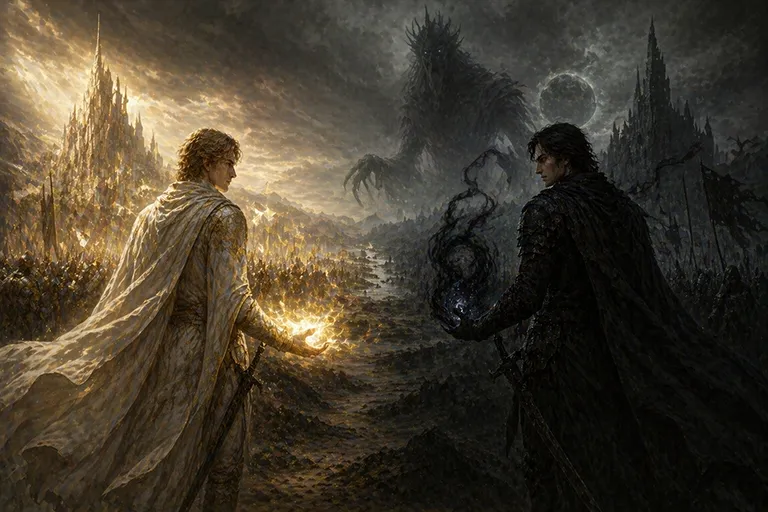
Janny Wurts published The Curse of the Mistwraith in 1993 and completed the eleventh and final volume, Song of the Mysteries, in 2024. Thirty-one years. Eleven books. Five arcs. Half-brothers Arithon s'Ffalenn and Lysaer s'Ilessid, cursed by a demon mistwraith to hate each other, carried across a continent and a philosophical register that no other author in epic fantasy has sustained for comparable length. Wurts's own paintings provide the cover art. Her worldbuilding of Athera deepens rather than sprawls. Readers who finish the series describe it in religious terms.
Wurts writes fantasy that refuses moral simplicity and demands prose attention. What follows is a curated comparison of six series within this intricate subgenre. My own work appears separately afterward and is clearly labeled as such.
What Wars of Light and Shadow Readers Are Actually Looking For
Wurts writes against three conventions that most epic fantasy accepts. She writes against clarity — her prose is lyrical and compressed, and her sentences require full attention. She writes against judgement — the Alliance of Light and the defenders of Arithon are both partially right and both partially damaged, and the narrative refuses to rescue either side. She writes against shortcut — her plot lines unfold over decades of in-world time and thirty years of publication, with no compression.
What this produces is a reading experience most readers find either impossible or essential. There is no middle register for Wars of Light and Shadow. The people who bounce off The Curse of the Mistwraith in its opening chapters never return. The people who push through to Arc II read all eleven volumes and argue that the series belongs in the highest tier of epic fantasy ever written.
So readers looking for books like Wars of Light and Shadow are actually looking for: a protagonist carrying a curse or burden the narrative refuses to lift, moral ambiguity without authorial verdict, prose that treats language as load-bearing rather than as transparent delivery, long-arc consequences that reward sustained commitment, and worldbuilding that deepens rather than expands.
1. The Second Apocalypse (R. Scott Bakker)
The Prince of Nothing (3 volumes) + The Aspect-Emperor (4 volumes) · 2003–2017 · Penguin / Overlook ·
Official Website
4.6/5
Personal rating by Christian Dölder · Author & Reader
Focus:
Philosophical Density
Moral Ambiguity
Prophecy-Haunted
R. Scott Bakker is a trained philosopher, and his Second Apocalypse reads like philosophy in fantasy clothing. Anasûrimbor Kellhus — a Dûnyain monk trained since childhood in the conditioning of logic and perception — emerges from the mountains into a world about to wage holy war. What follows across seven volumes is an interrogation of free will, faith, charisma, and the Consult's accelerating Second Apocalypse. Bakker's prose is dense. His thematic ambition is substantial. His characters are unreliable in ways that demand rereading.
The Wurts Factor
Philosophical ambition openly displayed. Kellhus operates at the moral register Wurts reserves for Lysaer at his most dangerous — a charismatic leader whose followers cannot see what he is. The Holy War of The Prince of Nothing is the structural equivalent of the Alliance of Light: an institution that is simultaneously a genuine faith, a political convenience and a trap. Bakker, like Wurts, refuses to tell the reader which reading is correct. Both authors demand patient, attentive reading.
How It Differs
Bakker is darker than Wurts. The Consult and the Inchoroi push the series into territory that is explicitly horrific in ways Wurts does not attempt. The philosophical interrogation is more explicitly argumentative; Bakker stages debates between his characters where Wurts stages compromised decisions. For Wurts readers ready for a harder, more argumentative philosophical fantasy, this is the closest living companion.
2. The Chronicles of Thomas Covenant (Stephen R. Donaldson)
Thomas Covenant · 10 volumes across First, Second, Last Chronicles · 1977–2013 · Del Rey / Gollancz ·
Official Website
4.5/5
Personal rating by Christian Dölder · Author & Reader
Focus:
Direct Arithon Ancestor
Cursed Protagonist
Ten-Volume Commitment
Stephen R. Donaldson wrote Lord Foul's Bane in 1977 — sixteen years before Wurts published The Curse of the Mistwraith. Thomas Covenant, an author diagnosed with leprosy and shunned by his society, is translated into a fantasy world called the Land and hailed as the reincarnation of a saviour. His response to this is refusal. He names himself the Unbeliever. He commits an act in the first volume that the series never lets him undo. Across ten volumes, Donaldson writes the burden of being the protagonist of a fantasy you do not want to be in.
The Wurts Factor
The direct structural ancestor of Arithon's predicament. Covenant carries a magical reputation — the white gold wielder, the prophesied champion — and will not play the role assigned to him. Donaldson, like Wurts, refuses to let the reader enjoy the protagonist uncritically. The Land is a setting of mythic beauty occupied by a traumatised narrator who cannot trust his perceptions. The prose is considered, occasionally difficult, always deliberate.
How It Differs
Donaldson's Land is more explicitly allegorical than Wurts's Athera. Covenant's leprosy in the primary world anchors the fantasy sections to a specific American 1970s psychology. The First Chronicles conclude in six books; the Second Chronicles and the Last Chronicles extend the project into territory some readers find baggy. For Wurts readers drawn to the cursed-protagonist structure above all other elements, Donaldson is the foundational text.
3. The Book of the New Sun (Gene Wolfe)
The Book of the New Sun · 4 volumes + Urth of the New Sun · 1980–1987 · Tor ·
About the Author
4.9/5
Personal rating by Christian Dölder · Author & Reader
Focus:
Literary Benchmark
Unreliable Narrator
Prose as Craft
Gene Wolfe is the author most frequently cited when literary-minded fantasy readers argue for the artistic legitimacy of the genre. The Book of the New Sun follows Severian, a journeyman of the torturers' guild on a far-future Urth where the sun is dying. Severian is writing the memoir himself, claims perfect memory, and contradicts himself within paragraphs. The reader must reconstruct the truth of events from the gaps and inconsistencies in the telling.
The Wurts Factor
The benchmark for prose as craft in the genre. Wolfe's sentences work at multiple levels simultaneously — plot, character, philosophical argument, pattern — in the same register Wurts operates in at her best. Moral unreliability treated seriously: Severian is a member of the torturers' guild and the reader is never allowed to comfortably dismiss what that means. The Autarch problem is structurally the Arithon problem at a different scale.
How It Differs
Wolfe is more compressed than Wurts — four volumes where Wurts takes eleven, with the narrative weight carried by single sentences where Wurts distributes it across paragraphs. The setting is science fictional in structure (a dying Earth in the far future) even though it reads as fantasy. The vocabulary is deliberately archaic. For Wurts readers who want the literary register distilled to its most rigorous, this is the source text.
 Epic High Fantasy
The Chronicles of Wetherid
Ready for a new reading adventure? Download the free book samples in PDF or EPUB format and unlock the high-resolution world map and original soundtrack.
Download Free Samples
4. Tigana (Guy Gavriel Kay)
Tigana · standalone novel · 1990 · Penguin Canada ·
Official Website
4.7/5
Personal rating by Christian Dölder · Author & Reader
Focus:
Literary Emotional Weight
Morally Grey Tyrant
Standalone Masterwork
Guy Gavriel Kay helped Christopher Tolkien edit The Silmarillion for publication in 1977 and has spent his career since writing literary historical fantasy. Tigana, published in 1990, is his masterpiece. The sorcerer-tyrant Brandin of Ygrath, grieving the death of his son, has used his magic to erase the name and memory of a single conquered province — Tigana — from the peninsula. The rebels who remember must restore the name before the last person who knew it dies.
The Wurts Factor
The Brandin problem is the Lysaer problem. A sympathetic tyrant whose grief is real, whose devotion to his slain son is real, and whose method of mourning is the erasure of an entire culture. The reader cannot comfortably hate him. Kay, like Wurts, refuses to give the reader the villain they want. The prose is lyrical, consciously literary, and slower than conventional fantasy.
How It Differs
Kay writes standalones and duologies, not multi-decade serial epic. Each of his books is a single, carefully shaped narrative. The settings are historical-analogue rather than fully secondary. Kay's magic is quieter than Wurts's and frequently ambiguous. For readers who want Wurts's moral ambiguity and literary prose in novel-length doses, Kay is the obvious entry point.
5. The Coldfire Trilogy (C. S. Friedman)
The Coldfire Trilogy · 3 volumes (complete) · 1991–1995 · DAW Books ·
Official Website
4.5/5
Personal rating by Christian Dölder · Author & Reader
Focus:
Philosophischen Dark Fantasy
Unholy Alliance
Underrated Classic
C. S. Friedman began The Coldfire Trilogy in 1991. The planet Erna shapes reality to the fears and hopes of its human colonists, meaning that nightmares become flesh in the forest. Damien Vryce, a priest of a young faith, must ally himself with Gerald Tarrant — a twelve-hundred-year-old Neocount who sold his soul to become a demon to preserve his church. The alliance is permanent. Neither man will renounce the other. Neither man can trust the other.
The Wurts Factor
The Vryce-Tarrant alliance is one of the great moral structures in epic fantasy, built on exactly the refusal Wurts specialises in. Tarrant is the genuine antagonist of the trilogy, yet also its co-protagonist. Friedman does not simplify him, redeem him, or explain him away. The partnership holds because the world requires it, not because anyone is healed.
How It Differs
Friedman's setting is science-fictional in origin, giving the fantasy a different philosophical grounding from Wurts's Athera. The trilogy is exactly three volumes and can be read in a month; Wurts demands years. Friedman's prose is more accessible, faster-moving and less lyrically dense. For Wurts readers who want the moral refusal without the decade-long commitment, this is the shortest rewarding entry.
6. The Farseer Trilogy (Robin Hobb)
Realm of the Elderlings · 3 volumes (Core Trilogy) · 1995–1997 · HarperVoyager ·
Official Website
4.7/5
Personal rating by Christian Dölder · Author & Reader
Focus:
Intimate Character Study
Uncompromising Loyalty
Generational Impact
Robin Hobb’s unmatched character-driven masterpiece stands alongside Wurts's epic as a towering standard of 900-page density and patient worldbuilding. FitzChivalry Farseer, royal bastard and trained assassin, navigates a lifetime of unchosen duties, heavy traumas, and magical isolation via the esoteric forces of the Skill and the Wit. Hobb treats emotional consequences as major plot elements that cannot be bypassed.
The Wurts Factor
A staggering focus on the long-term emotional and physical cost of loyalty. Hobb's method echoes Wurts's signature patience: she demands that her characters live in the debris of their choices for books at a time. The relationship between Fitz and the Fool mirrors the complicated, profound platonic bonds found throughout the history of Athera.
How It Differs
Hobb relies entirely on an ultra-intimate first-person retrospective voice rather than Wurts's sweeping multi-continental canvas. The setting of the Six Duchies is fundamentally less magical on the surface, focusing on isolated geographical strains rather than sprawling magical topologies. The full cycle encompasses 16 interconnected volumes across several trilogies.
A Note from the Author
Christian Dölder — The Chronicles of Wetherid
Cycle I: The Legacy of the Elves · Cycle II: The Guardians of the Seven Artifacts (2 volumes) · from 2024 · Verlag Christian Dölder · Multilingual Edition ·
Official Author Page
4.6/5
Personal rating by Christian Dölder · Author & Reader
Focus:
Moral Weight
Patient Layered Prose
Long-Arc Consequence
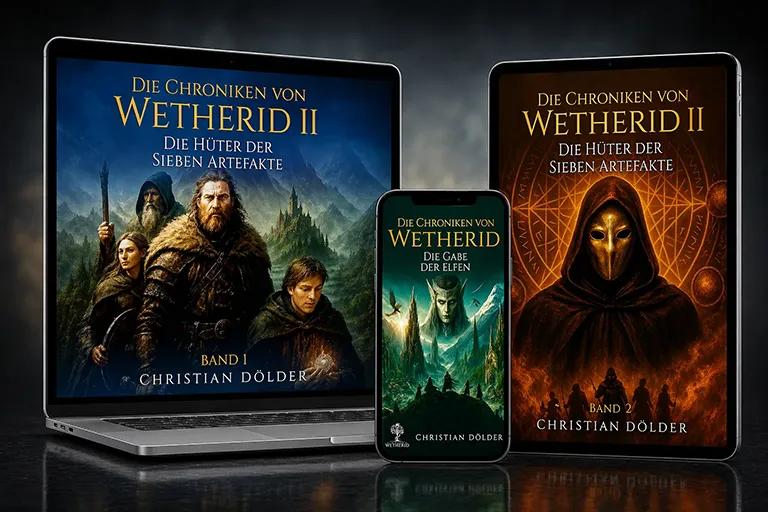
I present my own epic saga outside the classic, objective comparison parameters. As a writer, Janny Wurts’s monumental architecture has been a massive guiding star for my understanding of high fantasy. If you have finished the long road through Athera and crave an independent secondary world that dares to mimic her patience, structural refusal of moral simplicity, and long-arc consequences, I welcome you to Wetherid.
Moral Weight Over Moral Clarity
Wetherid refuses the clean moral map. The Mist Elves and the Glorious Elves are separated by an ancient divide that neither side fully remembers the cause of. Prince Sylvian of the Mist Elves is the kind of political antagonist Wurts readers recognise — not evil in the Mistwraith sense, but acting from a reading of his people's history that the narrative treats as partially legitimate. His blackmail of High Commander Elroth of the Glorious Elves is an act Wurts herself might have written: a morally compromised move by a character the reader cannot cleanly condemn, motivated by grievances the narrative does not dismiss.
Patient Layered Prose
The Dölder register is deliberate. Sentences are built rather than spilled. Paragraph structure carries meaning. Description is functional — every image earns its place in the scene — and the text trusts the reader to follow without authorial interruption. Written to be read at Wurts's pace rather than at the pace of contemporary commercial epic fantasy, it does not hurry, and does not reward hurrying.
Long-Arc Consequence
What happens in one volume stays expensive in the next. The losses at the battle of Ib'Agier, the political fractures opened in Astinhod, the guardians scattered across continents after the Legacy cycle — none of these heal easily. They become the load the later volumes carry. This is the Wurts principle: consequences accumulate. Characters do not recover from events the way commercial epic fantasy recovers from them.
The Right Book for Every Wurts Reader
The choice depends on which element of Wars of Light and Shadow you most want to follow. Readers who want the philosophical register at its most argumentative should start with Bakker. Readers who want the cursed-protagonist structure at its foundational should read Donaldson. Readers who want the prose-as-craft register at its most uncompromising should read Wolfe. Readers who want the moral refusal in standalone novel-length doses should read Kay. Readers who want the two-character moral alliance at its most refined should read Friedman.
Janny Wurts completed Wars of Light and Shadow with Song of the Mysteries in 2024. Readers arriving now have the advantage that earlier generations did not: a finished work. The series can be read as the single long project Wurts always intended rather than as a sequence of volumes interrupted by publication gaps. The companion novel To Ride Hell's Chasm and the Empire trilogy co-written with Raymond E. Feist offer additional Wurts reading once Athera is complete.
Each of the series named above stands on its own. None is a substitute for Wurts, and none pretends to be. What they share is the same underlying claim: that epic fantasy can operate at the literary register of any serious novel, that protagonists can carry curses the narrative does not lift, and that moral ambiguity is not a failure of craft but the subject of the work.
Frequently Asked Questions
What is the best book series similar to Wars of Light and Shadow?
R. Scott Bakker's The Second Apocalypse is the closest modern cousin in philosophical density and moral unreliability. For the cursed protagonist structure that Wurts builds around Arithon, Stephen R. Donaldson's Chronicles of Thomas Covenant is the direct ancestor — Covenant was carrying a curse of his own a generation before Arithon arrived. For readers who value Wurts's prose above all, Gene Wolfe's The Book of the New Sun is the literary benchmark the entire subgenre measures itself against.
Why is Janny Wurts considered so demanding to read?
Wurts refuses the usual concessions. Her prose is lyrical and compressed; readers cannot skim her paragraphs without losing the plot. Her politics are factional and shifting, with no authorial voice telling the reader which faction is correct. Her protagonist — Arithon s'Ffalenn — is magically cursed to be hated by his half-brother Lysaer and by the Alliance of Light, and the narrative refuses to rescue either brother from the curse that shapes them. Over eleven volumes completed across thirty years, the series sustains this moral ambiguity without release. Readers who want the consolation of a clear villain will not get it. Readers who stay with the series consistently describe it as one of the most rewarding commitments in epic fantasy.
Is Wars of Light and Shadow finished?
Yes. Janny Wurts completed the final eleventh volume, Song of the Mysteries, in 2024, twenty-nine years after The Curse of the Mistwraith appeared in 1993. The series is divided into five arcs: Arc I is Curse of the Mistwraith alone, Arc II covers books two and three, Arc III (Alliance of Light) runs across five books, Arc IV is the duology Sword of the Canon, and Arc V is the concluding eleventh book. Readers arriving now have the advantage of a complete work.
What exactly defines a book like Wars of Light and Shadow?
Four elements in combination. First, a protagonist who carries a curse, a burden or a fate that the narrative treats as genuinely irreversible rather than as a temporary obstacle. Second, moral ambiguity where opposing factions are both partially right and both partially damaged, with no authorial judgement settling the question. Third, dense, considered prose that treats language as a load-bearing element of the work rather than as transparent delivery. Fourth, long-arc consequences that unfold across many volumes with no narrative shortcuts. Books that share at least two of these elements carry the Wurts register.
Why has Janny Wurts remained under-recognised?
The genre has not always known how to read her. Her prose is denser than most contemporary epic fantasy. Her protagonist is disliked by most of the characters around him for reasons the reader can see but cannot resolve. Her worldbuilding of Athera takes hundreds of pages to cohere. Readers primed by faster-moving series have often bounced off the opening of The Curse of the Mistwraith. Those who stay with the series past the first arc consistently describe it as one of the great achievements of epic fantasy — a judgement that has grown louder as the final volumes have landed and the full shape of Wurts's project has become visible.