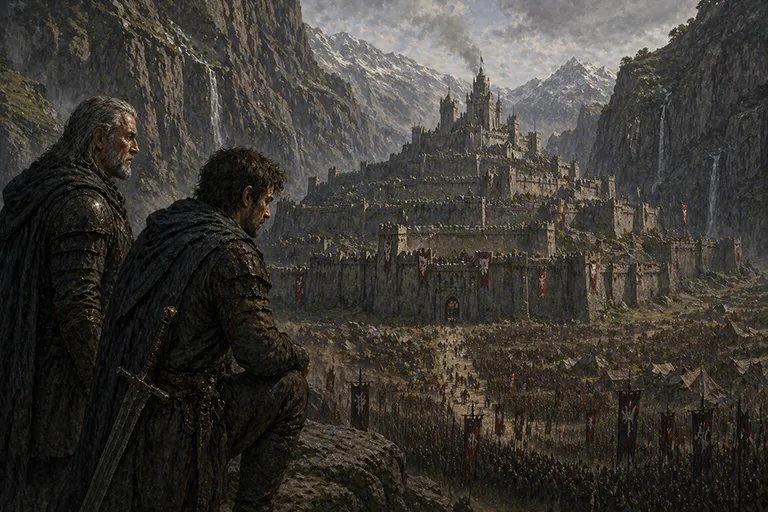
David Gemmell (1948–2006) wrote Legend in 1984, while recovering from what doctors believed was terminal cancer. The book is built around a question most epic fantasy avoids: what does a man do when he knows the siege cannot be won? Druss the Legend, an ageing axeman called out of retirement to defend the fortress of Dros Delnoch against the Nadir horde, became the template for an entire subgenre. Joe Abercrombie called Gemmell "the hardbitten champion of British heroic fantasy." Brent Weeks called him "adrenaline with soul." Over the next twenty-two years Gemmell produced fifteen Drenai novels, the Rigante cycle, the Jon Shannow books, and the Troy trilogy, writing until his death in 2006.
Gemmell's innovation was the treatment of his fighters — exhausting, dirty, tactically specific, with visceral stakes. What follows is an uncompromised, structurally rigorous guide to the most exceptional series carrying this direct martial heritage.
What Drenai Readers Are Actually Looking For
Gemmell's innovation was not the fortress defence. Classical epic fantasy had its sieges before him. His innovation was the treatment of the fighters. Druss is old, tired and knows it. Rek is afraid and says so. Waylander is a killer who will never be clean of it. Gemmell refused the convention of the flawless hero. He also refused the convention of the irredeemable villain. Ulric, the Nadir warlord at the gates of Dros Delnoch, is given honour and reason. The reader who finishes Legend is not told who to hate.
The second innovation was the scale of the battles. Gemmell wrote sieges the way a former soldier writes them — exhausting, dirty, tactically specific, with losses that matter. Wounds are described by the bone they broke rather than by the glory they earned. Defenders die of thirst and infection, not only of swords. This specificity is the register his successors inherit.
So readers looking for books like the Drenai Saga are actually looking for: a warrior protagonist whose fighting skill is craft rather than magic, a plot driven by a specific martial situation rather than by prophecy, morally flawed heroes who act honourably despite themselves, morally ambiguous villains explained rather than excused, and battle writing that respects the physical reality of combat.
1. Blood Song (Anthony Ryan)
Raven's Shadow Trilogy · 3 volumes + Raven's Blade duology · from 2011 · Ace Books / Orbit ·
Official Website
4.7/5
Personal rating by Christian Dölder · Author & Reader
Focus:
Direct Gemmell Successor
Warrior Coming-of-Age
Self-Published Breakthrough
Anthony Ryan has publicly named David Gemmell as one of two primary influences on Blood Song, alongside Robin Hobb. The lineage is visible on every page. Vaelin Al Sorna, a boy given to the Sixth Order of the Faith at the age of ten, trained through years of brutal martial discipline, emerges as the kind of warrior Druss would recognise. The book was originally self-published in 2011 and sold well enough to attract the Ace Books contract that delivered the full trilogy.
The Gemmell Factor
Fighting skill treated as craft that must be paid for in sweat, bruises and lost years. A protagonist whose reputation outpaces him and whose reputation he cannot escape — the Druss problem, updated for a new protagonist. A kingdom in political transition whose armies are operating under leadership that does not deserve them. Combat writing that owes more to Gemmell's battle scenes than to any of Ryan's American contemporaries.
How It Differs
The Hobb influence is equally visible in the emotional interiority. Vaelin carries guilt and loss more explicitly than Druss does. The series moves from martial-boarding-school opening into larger political and theological stakes, ending in territory closer to epic fantasy than to pure heroic. The sequel duology Raven's Blade continues Vaelin's story after the trilogy closes. For Drenai readers who want Gemmell's craft transposed into a modern voice, this is the first stop.
2. The Black Company (Glen Cook)
The Black Company · 10 volumes · 1984–2018 · Tor Books ·
Publisher Site
4.6/5
Personal rating by Christian Dölder · Author & Reader
Focus:
Mercenary Register
Gemmell-Era Classic
Soldier's-Eye View
Glen Cook began The Black Company in 1984, the same year Gemmell published Legend. The two authors arrived at similar conclusions from different directions. Cook, a Vietnam veteran, wrote fantasy the way he thought soldiers would have experienced it — through the eyes of a field medic named Croaker, chronicler of a mercenary company that sells itself to the highest bidder and often regrets the contract. The book that follows is the foundational text of what later got labelled grimdark.
The Gemmell Factor
Warriors treated as professionals with specific expertise, not as destined heroes. Moral compromise as the default condition of soldiering. Battle described from the perspective of the people fighting it rather than from the perspective of a general looking at a map. The Black Company's medical sergeant is in some ways the prose-equivalent of Gemmell's injured Druss: the man who sees what actually happens to bodies in a war.
How It Differs
Cook's prose is starker than Gemmell's — short sentences, clipped dialogue, grim humour. The magic in Cook's world is bigger and more alien than anything Gemmell wrote; the Lady and the Dominator function at continental scale. The ten-volume Glittering Stone arc across later books moves the focus to the south of the world and demands more patience. For Gemmell readers who want the mercenary register at its most distilled, start with the first volume alone.
3. The Legend of Drizzt (R. A. Salvatore)
Forgotten Realms / The Legend of Drizzt · 40+ novels · from 1988 · Wizards of the Coast ·
Official Website
4.4/5
Personal rating by Christian Dölder · Author & Reader
Focus:
Iconic Lone Warrior
Sword & Sorcery Tradition
Accessible Entry Point
R. A. Salvatore launched Drizzt Do'Urden in 1988, four years after Legend. Across more than forty novels since, Drizzt has become one of the few fantasy protagonists who can stand alongside Druss as a cultural landmark of the form. The books are set in the Forgotten Realms, the shared Dungeons & Dragons universe, but Drizzt's own story operates at the scale Gemmell worked at: a single warrior with a code, a reputation he did not ask for, and a set of loyalties he refuses to renounce.
The Gemmell Factor
The lone-warrior archetype at its most iconic. Drizzt's combat writing — Salvatore choreographs each sword-fight with the precision of a stage director — sits in the same lineage as Gemmell's axeman encounters. The companions of the Companions of the Hall are functionally the Drenai supporting cast: a dwarf, a barbarian, a halfling, a ranger, each with a tactical role and a refusal to leave a wounded brother. The loyalty is the spine of the books.
How It Differs
The Forgotten Realms is a shared setting with pre-existing cosmology, which gives Drizzt a larger magical context than anything in Drenai. The register is brighter and more heroic than Gemmell's — Drizzt does not carry Druss's weight of regret. The series is enormous; The Crystal Shard or Homeland are the usual entry points. Readers who want Gemmell's lone-warrior ethic at its purest, with less moral fatigue, should start here.
 Epic High Fantasy
The Chronicles of Wetherid
Ready for a new reading adventure? Download the free book samples in PDF or EPUB format and unlock the high-resolution world map and original soundtrack.
Download Free Samples
4. The Traitor Son Cycle (Miles Cameron)
The Traitor Son Cycle · 5 volumes · 2012–2017 · Gollancz / Orbit ·
Official Website
4.5/5
Personal rating by Christian Dölder · Author & Reader
Focus:
Modern Martial Fantasy
Historical Precision
Siege Warfare
Miles Cameron is the pen name of Christian Cameron, a former naval officer and committed historical re-enactor who has spent decades studying medieval combat. The Traitor Son Cycle opens with a siege — the Red Knight's mercenary company contracted to defend an abbey against creatures from the Wild — and builds across five volumes into a larger conflict that involves the Kingdom of Alba, the Wild, the Empire, and a theological struggle that none of the military commanders fully understand.
The Gemmell Factor
Siege warfare written by an author who has practised wearing a hundredweight of armour. The mercenary company structure, the tactical use of professional soldiers under contract, the specificity of medieval logistics — this is Gemmell's world extended with historical rigour. The Red Knight himself is a younger Druss with magical access: proud, skilled, carrying guilts that surface at the wrong moments.
How It Differs
Cameron's magic is denser than Gemmell's. The setting is a plausible medieval Europe with theological and political structures intact, and the series moves into larger strategic complications that Gemmell rarely attempted. The prose is more detailed than Gemmell's — some readers find it the denser read. For Drenai readers who want siege writing with historical armour-plate precision, no contemporary author is closer.
5. The Ten Thousand (Paul Kearney)
The Macht Trilogy · 3 volumes (complete) · 2008–2011 · Solaris Books ·
Publisher Site
4.5/5
Personal rating by Christian Dölder · Author & Reader
Focus:
Xenophon's Anabasis
Phalanx Warfare
Underrated Masterwork
Paul Kearney is one of the most under-recognised heroic fantasy authors of the last twenty years. The Ten Thousand is his direct engagement with Xenophon's Anabasis — the true account of ten thousand Greek mercenaries stranded deep inside the Persian Empire, marching home through hostile territory. Kearney rewrites the episode as fantasy: the Macht, a phalanx-fighting people of mercenary tradition, hired by a Kufr prince who loses the battle that should have put him on the throne. The march home begins on page one hundred.
The Gemmell Factor
Professional soldiering as craft and identity. The Macht phalanx fights as a trained unit, not as a collection of individual heroes — but individual heroes emerge from within it. Rictus, the young spearman who becomes the novel's centre of gravity, carries the same register as young Rek in Legend: afraid, competent, carried forward by the men on either side of him. Kearney's battle writing is as specific as Gemmell's and arguably more tactically rigorous.
How It Differs
The world is low-magic — no dragons, no prophecies, no ancient evil. The Macht are outnumbered, culturally alien to their Kufr employers, and their fight is entirely human. Kearney writes in a denser, more literary register than Gemmell. The Monarchies of God pentalogy, his earlier series, offers a closer structural parallel to Drenai if readers want more Kearney after the Macht trilogy closes.
6. The Faithful and the Fallen (John Gwynne)
The Faithful and the Fallen · 4 volumes (complete) · 2012–2016 · Orbit Books ·
Official Website
4.6/5
Personal rating by Christian Dölder · Author & Reader
Focus:
Modern Heroic Spirit
Shield-Wall Combat
Unyielding Brotherhood
John Gwynne’s breakthrough tetralogy is widely regarded as the ultimate contemporary standard for classic heroic fantasy. Centered around Corban, a young blacksmith’s apprentice training to find his footing as a warrior, the saga quickly escalates into a brutal, heartfelt conflict across the Banished Lands where giants, ancient bloodlines, and a war of angels and demons collide.
The Gemmell Factor
The series runs completely on Gemmell fuel: visceral, grounded weapon-craft, bone-tiring shield walls, and deep codes of brotherhood. Characters are pushed to the brink of despair but find an internal moral compass that demands they hold the wall anyway. The battle scenes, particularly during desperate defensive stands, evoke the exact emotional weight of Dros Delnoch.
How It Differs
Gwynne relies more explicitly on an ancient prophecy model—God-Born vs. Sun-Sworn—than Gemmell's plot-driven frameworks usually allowed, though he masterfully subverts who the actual "Chosen" characters are. The viewpoint distribution is wider, cutting between a broader cast of companions and opposing political houses.
Author's Own Work · Personal Comparison

Christian Dölder — How Wetherid Honours the Soul of Heroic Siegecraft
Cycle I: The Legacy of the Elves · Cycle II: The Guardians of the Seven Artifacts · from 2024 · Verlag Christian Dölder · Multilingual Sagas ·
Author Page
4.6/5
Personal rating by Christian Dölder · Author & Reader
Focus:
Siege at Ib'Agier
Outnumbered Stand
Tactical Combat Craft
I place my own saga distinctly outside the primary comparison index. David Gemmell’s Legend wasn't just a book to me; it was the ultimate demonstration of how a desperate, outmatched group can form an unbreakable moral axis behind stone walls. If you are looking for that specific feeling of an arithmetic countdown against an unstoppable horde, I invite you to read my work.
The Siege at Ib'Agier
Midway through The Legacy of the Elves, the companion group arrives at Ib'Agier, an ancient mountain fortress held by the Grey Dwarves. An army of Xaroth's forces quickly cuts them off and surrounds the walls. The defenders are drastically outnumbered. What follows is an explicit tribute to the register Gemmell perfected: professional soldiers and desperate exiles checking their gear, patching up breaches, and counting their arrow supplies as the enemy systematically erodes their defences. It is an exercise in slow, costly arithmetic where every hours-long stand must be bought in sweat and blood.
Warriors Built on Craft, Not Magic
Gorathdin, the elven ranger at the emotional core of the narrative, carries the specific heavy fatigue Gemmell reserved for characters like Druss or Waylander. He is highly skilled but thoroughly tired, acutely aware of what combat costs, and driven by a strict code of internal loyalty that forbids abandoning a fallen companion. His close-quarters weapon craft during the desperate defensive pushes along the ramparts is written with a strict respect for physical exhaustion, fear, and weapon degradation.
The Fine Print (Refusing the Simple Path)
Wetherid functions within a deep secondary framework of 21 distinct peoples (including four separate elven Unterarten and rival dwarf factions), requiring more world-immersion from the reader than Gemmell's rapid-fire pace usually demanded. My prose is paratachisch-trocken — sparse, clinical, and dry, avoiding open melodrama or pulp simplicity. The historical weight is dense, but for readers who miss the absolute soul of an outnumbered stand, the walls of Ib'Agier are ready.
The Right Book for Every Drenai Reader
The choice depends on which element of Gemmell you most want to follow. Readers who want the direct modern successor with Ryan's Gemmell-cited discipline should start with Blood Song. Readers who want the mercenary register at its grittiest should read Cook. Readers who want the lone-warrior archetype with less moral fatigue should read Salvatore. Readers who want the siege writing with medieval armour-plate precision should read Cameron. Readers who want the phalanx-and-march discipline with historical rigour should read Kearney.
Gemmell himself wrote fifteen Drenai novels, the three-volume Rigante cycle, the four-volume Jon Shannow sequence, the Troy trilogy (completed posthumously by his wife Stella from his notes), and standalones including Lion of Macedon and Knights of Dark Renown. Readers who have finished Legend should not leave Drenai yet. The First Chronicles of Druss the Legend and Waylander are the obvious next stops. The Rigante books move the register into a Celtic-influenced setting. The Troy trilogy is Gemmell's historical masterpiece.
Each of the series named above stands on its own. None is a substitute for Gemmell, and none pretends to be. What they share is the same underlying claim: that a warrior protagonist can carry an epic story, that a siege can be the centre of a novel rather than a backdrop, and that honour is something a character does rather than something a character claims.
Frequently Asked Questions
What is the best book series similar to the Drenai Saga?
Anthony Ryan's Blood Song is a strong modern successor in its warrior-focused coming-of-age story and military fantasy elements. For the mercenary register that Gemmell perfected in Waylander and The First Chronicles of Druss, Glen Cook's The Black Company is an especially close companion. For the lone-warrior fantasy archetype, R. A. Salvatore's Legend of Drizzt offers another clear point of comparison with Druss the Legend.
Why is David Gemmell considered the king of heroic fantasy?
Gemmell wrote Legend in 1984 while recovering from what doctors believed was terminal cancer. The book is built around a question that most epic fantasy avoids: what does a man do when he knows the siege cannot be won? Druss the Legend, an ageing axeman called out of retirement to defend the fortress of Dros Delnoch against the Nadir horde, became the template for an entire subgenre. Joe Abercrombie and Brent Weeks have both called Gemmell a primary influence. His later historical novels — Lion of Macedon, the Troy trilogy, the Rigante books — carry the same register into adjacent worlds. Gemmell died in 2006 with the final Troy novel completed by his wife Stella from his notes.
Which of these series feature last-stand siege warfare specifically?
Paul Kearney's The Ten Thousand, modelled on Xenophon's Anabasis, is the closest pure-warfare match to Gemmell's battle writing. Miles Cameron's The Red Knight opens on a siege and centres much of its narrative on field tactics. Anthony Ryan's Blood Song contains several major siege sequences. Glen Cook's Black Company operates in near-constant warfare of different scales. John Gwynne's The Faithful and the Fallen excels at siege craft and shield-wall confrontations.
What exactly defines a book like the Drenai Saga?
Four elements in combination. First, a warrior protagonist whose fighting skill is treated as craft rather than magic. Second, a plot driven by a specific martial situation — a siege, a long retreat, a final battle — rather than by prophecy. Third, morally flawed heroes who act honourably despite themselves, and morally ambiguous villains who are explained rather than excused. Fourth, battle writing that respects the physical reality of combat: fatigue, fear, the weight of armour, the price of survival. Books that share at least two of these elements carry the Gemmell register.
Which Drenai book should a new reader start with?
Legend (1984) is the natural entry point — it is Gemmell's breakthrough, the book that introduces Druss, and complete on its own terms. Readers who want Druss's earlier life should read The First Chronicles of Druss the Legend next. Readers drawn to the amoral assassin archetype should start with Waylander instead, which can be read independently of Legend. The Drenai books can be read in publication order or in internal chronological order; publication order preserves the way Gemmell's craft evolved. Outside the Drenai saga, the Rigante books (Sword in the Storm onwards) and the Troy trilogy are equally rewarding.