If you search for books like Lord of the Rings, you will find the same names on every list: Brandon Sanderson, Robert Jordan, George R.R. Martin, Tad Williams, Robin Hobb. They are solid recommendations. They are also the recommendations that appear on every single article on the internet. If you already know them, you do not need another list repeating the same titles.
This list is different. It contains ten books and series that will appeal to Tolkien fans for different reasons – the depth of worldbuilding, the seriousness, the atmosphere, or the specific feeling that makes Middle-earth unique. Some are classics that remain less widely known, while others are fresh discoveries. What they share is being absent from standard recommendation lists.
I am an epic fantasy author myself and have been reading the genre for over twenty years. This selection is based on that reading experience. If you felt a void after the last page of The Return of the King and are looking for something that fills it honestly – without being a mere copy – you will find it here.
1. Der Krieg der Propheten (R. Scott Bakker)
Original Title: The Prince of Nothing · 3 Volumes · Klett-Cotta / Heyne · English & German Edition
4.7/5
Rated by Christian Dölder
Official Website
Focus:
Philosophical Depth
Dense Prose
Dark World
R. Scott Bakker is a philosopher and novelist. His trilogy is set on the continent of Eärwa, where a Holy War erupts that mirrors the First Crusade. Into this world steps Anasûrimbor Kellhus – a monk from an isolated sect that has trained pure logic for millennia. What follows is a game of manipulation, faith, and power unlike anything else in fantasy.
Bakker combines Tolkien's depth of worldbuilding with a degree of philosophical complexity that reaches far beyond the genre. His world has its own languages, peoples, and a history stretching back thousands of years. The tone is dark, the prose dense, the moral questions uncomfortable. This is not an easy read. It is one of the best.
If what you love about Tolkien is the seriousness and the depth of history, you will be rewarded here. If you have read both Tolkien and Martin and are looking for the next step – an author who pushes the genre intellectually – Bakker is where you find it.
2. Die Erdsee-Romane (Ursula K. Le Guin)
Original Title: Earthsea Cycle · 6 Volumes · from 1968 · Multilingual Edition
4.8/5
Rated by Christian Dölder
Official Website
Focus:
Archipelago Fantasy
Magic with Consequences
Quiet Grandeur
In the years following the publication of The Lord of the Rings, the Earthsea Cycle emerged as a work that absorbed Tolkien's influence and took it in an entirely different direction. Le Guin tells the story of the wizard Ged – from his first catastrophic mistake to his final journey.
The books are shorter than Tolkien's works but no less dense. Le Guin writes about magic that has consequences. About power that is not defined by strength. About an archipelago world where every name carries weight. The atmosphere is quieter than Tolkien's, but equally suffused with the feeling that the world is old and harbours secrets best left undisturbed.
Earthsea often features on academic reading lists but rarely on the "books like Lord of the Rings" lists that dominate search results. That is an oversight. If what you love about Tolkien is the melancholy – the sense that something great is ending – you will read Le Guin with profit.
3. Stein und Flöte (Hans Bemmann)
Original Title: The Stone and the Flute · 1 Volume · 1983 · Nymphenburger / Penguin (EN)
4.7/5
Rated by Christian Dölder
About the Author (Wikipedia)
Focus:
German-Language Origin
Fairy-Tale Like
Linguistic Precision
This book is a special case. Hans Bemmann, a German author and literary editor, wrote The Stone and the Flute as a novel that resists easy genre classification. Among those who have read it, it is recommended with a fervour otherwise reserved for Tolkien fans.
The story follows Dorin Dorunson, who inherits three objects – a stone, a flute, and a horse – and travels through a world that exists somewhere between fairy tale and epic. Bemmann tells his story slowly, patiently, with a linguistic precision that echoes Tolkien's own care. There are no battles. There are no heroes in the conventional sense. But there is a depth of narrative that settles into the reader and stays there.
The English translation by Anthea Bell – one of the most respected literary translators in Europe – was published by Penguin. The book has never gained the audience it deserves in the anglophone world. It should.
 Epic High Fantasy
The Chronicles of Wetherid
Ready for a new reading adventure? Download the free book samples in PDF or EPUB format and unlock the high-resolution world map and original soundtrack.
Download Free Samples
4. The Deed of Paksenarrion (Elizabeth Moon)
3 Volumes (often in omnibus edition) · 1988–1989 · Baen Books
4.5/5
Rated by Christian Dölder
Official Website
Focus:
Military Fantasy
Hero's Journey
Realism
Paksenarrion – Paks – is a sheepfarmer's daughter who flees an arranged marriage and joins a mercenary company. What begins as straightforward military fantasy develops over three volumes into a hero's journey whose emotional force is unexpected.
Elizabeth Moon served as an officer in the US Marine Corps. It shows. The depiction of soldiering – the training, the hierarchies, the camaraderie – is realistic and free of romanticisation. But the story goes further. In the final volume, Paks is confronted with something that recalls the trials of Tolkien's great figures: the loss of everything that defines her, and the question of whether she carries on regardless.
The book is widely considered one of the most underrated works in the genre. It is accessible, honest, and builds to a conclusion that earns its emotional weight.
5. The Chronicles of Narnia (C.S. Lewis)
Original Title: The Chronicles of Narnia · 7 Volumes · 1950–1956 · Geoffrey Bles / HarperCollins
4.6/5
Rated by Christian Dölder
Official Website
Focus:
Mythological Depth
Classic High Fantasy
Tolkien Companion
C.S. Lewis was J.R.R. Tolkien's closest friend and colleague at Oxford, and a core member of the "Inklings" literary circle. His seven-volume Narnia chronicle stands as an unassailable milestone of classical high fantasy, crafting an immersive world hidden behind a wardrobe where talking beasts, mythological creatures, and the Great Lion Aslan contend against eternal winter.
The parallels in their deep, mythopoeic understanding of world-building and spiritual rescue are unmistakable. While Tolkien grounded Middle-earth in philology and language, Lewis constructed a vivid tapestry woven from Norse, classical, and Christian allegories that has captivated generations.
For readers tracing the golden age of high fantasy, exploring the world built by Tolkien's closest confidant offers the ultimate historical and thematic companion piece.
6. The Riddle-Master (Patricia McKillip)
Original Title: The Riddle-Master of Hed · 3 Volumes · 1976–1979 · Atheneum / Ace
4.7/5
Rated by Christian Dölder
Official Website
Focus:
Poetic Prose
Riddles and Magic
Tolkien Affinity
Patricia McKillip is the author that Tolkien fans most often do not know – and most often love when they discover her. Her Riddle-Master trilogy tells of Morgon, a swineherd and land-heir who, by solving an ancient riddle, is drawn into events far beyond his understanding.
McKillip writes in prose that is frequently described as poetic but never decorative. Every word carries weight. Her world is threaded with riddles, ancient magic, and an atmosphere reminiscent of Tolkien's Elves – the feeling that everything in this world was once known and much has been forgotten.
McKillip is widely discussed in the context of Tolkien's legacy. Literary critics have traced his influence on her approach to language and atmosphere. If you value his stylistic care, McKillip is an author who takes that approach in her own direction.
7. The Long Price Quartet (Daniel Abraham)
4 Volumes · 2006–2009 · Tor Books
4.6/5
Rated by Christian Dölder
Official Website
Focus:
East-Asian Inspired
Ageing and Consequence
Innovative Magic System
Daniel Abraham is known to most as the co-author of The Expanse. His solo work – The Long Price Quartet – is far less well known and deserves to be read. The series is set in a world inspired by East Asian cultures, where poets can bind abstract concepts into living beings. One city controls the "andat" for cotton and thereby dominates world trade. Another controls the one for pregnancy.
This sounds abstract, but Abraham tells it with a clarity and emotional precision that impresses. The four volumes span decades and follow the consequences of decisions made in volume one. It is a story about ageing, the price of power, and friendships that fracture under the weight of history.
If what you value in Tolkien is that decisions carry weight and nothing passes without consequence, you will value Abraham.
8. Die Chroniken von Prydain (Lloyd Alexander)
Original Title: The Chronicles of Prydain · 5 Volumes · 1964–1968 · Holt, Rinehart and Winston
4.6/5
Rated by Christian Dölder
About the Author (Wikipedia)
Focus:
Welsh Mythology
Coming-of-Age
Maturation Process
Lloyd Alexander wrote his Prydain series for young readers. That changes nothing about the fact that it belongs among the finest works in fantasy. The world is drawn from Welsh mythology. The protagonist Taran – an assistant pig-keeper – grows across five volumes from boy to man, and Alexander shows this process with an honesty that many adult novels lack.
The fourth volume, Taran Wanderer, has no antagonist. No quest. No romance. Taran travels through the land and talks with a potter about what constitutes a good life. It is one of the best fantasy volumes ever written.
If what you love about Tolkien is the human element – the hobbits who return home and find that their home has changed – you will find the same quality in Alexander, in concentrated form.
9. The Worm Ouroboros (E.R. Eddison)
1 Volume · 1922 · Public Domain (Project Gutenberg)
4.3/5
Rated by Christian Dölder
Full Text (Project Gutenberg)
Focus:
Archaic English
Tolkien Inspiration
1922 Classic
This book predates The Lord of the Rings. Tolkien read it, admired it, drew inspiration from it – and also criticised it for lacking moral depth. Eddison wrote in an archaic English that is challenging even for native speakers. The story tells of the war between the Lords of Demonland and the Witch-King Gorice of Witchland.
Eddison's strength lies in his language and the force of his imagery. His battle scenes rank among the most powerful in English-language fantasy. His world lacks Tolkien's structured historiography – but it possesses a raw, poetic power that strikes directly.
This book is not for everyone. But if you have read Tolkien's Appendices and wished you could experience the Age of Wars firsthand – in a language suited to that age – you should try it.
10. The Sun Sword (Michelle West)
6 Volumes · 1997–2004 · DAW Books
4.6/5
Rated by Christian Dölder
Official Website
Focus:
Political Fantasy
Strong Female Characters
Epic Ensemble
Michelle West is the most underrated author in epic fantasy. Her Sun Sword series is set in the Essalieyan Empire and tells of a war between the northern and southern continents, in which Diora – a woman whose voice holds magical power – stands between the opposing sides.
West combines epic scale with character work that is rare in the genre. Her characters make decisions under pressure – moral compromises, political calculations, personal sacrifices – and West gives each of these decisions space and weight. The worldbuilding is detailed and deep, the mythology of the Essalieyan universe spanning multiple series.
If what you love about Tolkien is the grandeur of the storytelling – the sense that behind every story lies a still greater one – you will find it in West. This series appears on no major recommendation list. It should.
Author's Perspective
Tolkien as a North Star: How Wetherid Honours the Legacy of Middle-earth
J.R.R. Tolkien didn't just write a book with The Lord of the Rings; he established an entire genre. What continues to captivate us as readers to this day is the absolute seriousness of his world, the melancholy of a fading epoch, and the unshakeable feeling that a millennia-old history slumbers behind every single hill.
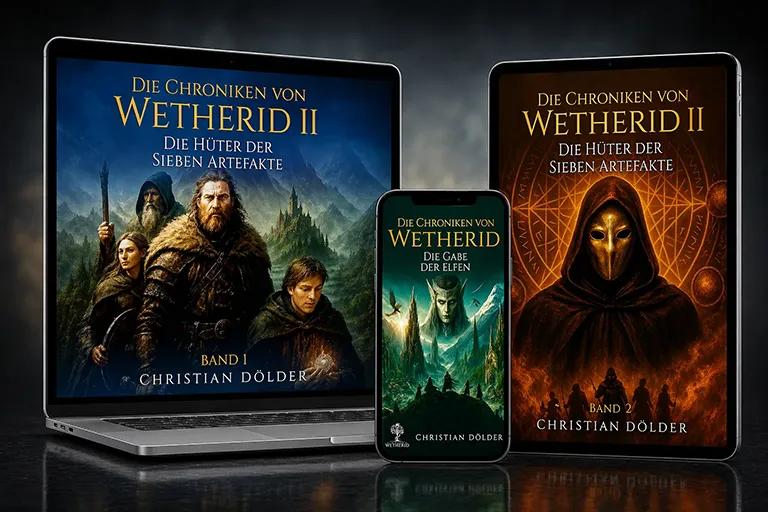
When I began reading the genre intensively over twenty years ago and eventually started writing myself, Tolkien's mythic depth was my most important compass. My goal with The Chronicles of Wetherid Sagas was to revive this classic, reverent feeling of high fantasy — far removed from the fast-paced, often shallow trends of our modern times.
Why Wetherid Was Conceived for Tolkien Enthusiasts:
Deep World-Building: No fictional worlds created on a whim. Wetherid offers 21 peoples, over 140 historically anchored characters, and a geography that actively shapes and influences the plot.
Mythic Melancholy: The world is old and scarred by past wars and ancient alliances. Its peoples face existential trials that demand genuine sacrifice.
Linguistic Care: A strict focus on atmospheric density and a respectful, epic tone of voice.
If you are looking to fill the void left by Middle-earth, I invite you to step onto the pathways of Wetherid.
Frequently Asked Questions
Why are Sanderson, Jordan, and Martin not on this list?
Because they appear on every other list. The Stormlight Archive, The Wheel of Time, and A Song of Ice and Fire are excellent recommendations – but anyone who does not already know them has probably never searched for books like Lord of the Rings.
Which book on this list comes closest to Tolkien?
That depends on what you value most in Tolkien. If you love the power of language: The Worm Ouroboros. If you seek deep worldbuilding: R. Scott Bakker. If you miss the melancholy and quiet grandeur: Ursula K. Le Guin or Patricia McKillip. If you want a classic fellowship quest with a modern voice: The Chronicles of Wetherid.
Are any of these available in translation?
The Earthsea Cycle, The Prince of Nothing, and The Chronicles of Prydain are available in multiple languages. The Stone and the Flute has an English translation by Anthea Bell. The Chronicles of Wetherid are published in German, English, French, and Spanish. The Worm Ouroboros is freely available online through Project Gutenberg. The Deed of Paksenarrion, The Riddle-Master, The Long Price Quartet, and The Sun Sword are currently only available in English.
What makes a good Tolkien equivalent?
Tolkien defined four qualities that together make his work distinctive: detailed worldbuilding with its own history, a serious tone without irony, language suited to its world, and the sense that behind the story being told lies a deeper one still. Books that share at least two of these qualities come closest to the Tolkien feeling.