Robin Hobb published Assassin's Apprentice in 1995. Twenty-two years later, Assassin's Fate closed the sixteen-volume Realm of the Elderlings in 2017. Between those two covers sits one of the longest sustained first-person performances in modern fantasy — FitzChivalry Farseer, the bastard son of a prince, narrated from inside his own wounded consciousness for thousands of pages. George R. R. Martin's public verdict is well known: Hobb's books are diamonds in a sea of zircons.
What follows is a completely objective, non-commercial guide mapping the most deeply realized character-centric epics in the genre.
What Robin Hobb Readers Are Actually Looking For
The Farseer Trilogy is technically a coming-of-age story about a royal bastard trained as an assassin. That description misses the centre of the book. Hobb's project is interior. Fitz's moral wounds, his unchosen loyalty to a kingdom that will not acknowledge him, his bond with the wolf Nighteyes, his ambivalent companionship with the Fool — these are the spine of the series. The political plot moves around them rather than through them.
The Six Duchies are a functional medieval setting, not an elaborate secondary world in the Tolkien or Jordan sense. The magic systems — the Skill and the Wit — are intimate rather than spectacular. Reader investment comes from emotional residence, not worldbuilding display. That is the key difference between Hobb and almost everything else in the genre.
So readers looking for books like the Farseer Trilogy are actually looking for: a protagonist whose interior life is the centre of the book rather than its engine, a patient narrative that refuses to skip emotional consequences, loyalty as a recurring moral burden carried at real cost, magic that operates intimately rather than spectacularly, and prose that treats the reader as a companion rather than an audience.
1. Crown of Stars (Kate Elliott)
Crown of Stars · 7 volumes (complete) · 1997–2006 · DAW Books ·
Official Website
4.6/5
Rating by Christian Dölder
Focus:
Character-Driven Epic
Medieval Politics
Dual Protagonists
Kate Elliott began Crown of Stars in 1997, two years after Assassin's Apprentice. The seven-volume series follows two protagonists — Liath, a young woman with a dangerous heritage, and Alain, a peasant boy drawn into the church — through a late-medieval-analogue world where theology, dynastic politics and half-remembered elder magic collide. The worldbuilding is denser than Hobb's, but the emotional method is the same: let the reader live inside the protagonist's choices for as long as it takes.
The Hobb Factor
Both authors write patient, emotionally sustained epic fantasy anchored in character rather than spectacle. Elliott's Alain — a boy with an unshakeable moral core, carried by uncanny hounds — reads as the closest structural cousin to Fitz on this list. Loyalty, social powerlessness, a connection to non-human intelligence, and a slow accumulation of emotional debt define both narratives.
How It Differs
Elliott's viewpoint rotates across multiple characters; Hobb stays close to Fitz. The setting is larger, with a defined theological structure and a more visible political map. The seven volumes are complete, with an earned ending — a reward Hobb readers will recognise from Assassin's Fate, though Elliott arrives there faster.
2. The Curse of Chalion (Lois McMaster Bujold)
World of the Five Gods · standalone novel + sequels · from 2001 · Eos / Harper Voyager ·
Official Website
4.8/5
Rating by Christian Dölder
Focus:
Most-Cited Hobb Pairing
Wounded Protagonist
Hugo Winner
The Curse of Chalion is the most frequently recommended match for Farseer readers in fantasy fan communities, for a single reason: Cazaril. A former courtier and galley slave returning broken to the royal court he once served, Cazaril accepts the position of tutor to the princess Iselle and finds himself drawn into the curse that has shadowed the royal line for generations. He is the closest companion portrait to FitzChivalry Farseer that modern fantasy has produced.
The Hobb Factor
The interior life of a wounded, loyal servant carrying a burden he did not ask for — the same engine that powers the Farseer books. Cazaril's moral weight, his quiet competence in the face of manipulative nobility, and his cost-bearing devotion to Iselle parallel Fitz's relationship with Verity and Kettricken almost line for line. The Hugo-winning Paladin of Souls takes that method further with an older female protagonist.
How It Differs
Bujold's prose is tighter and her pacing faster than Hobb's. The theological architecture — five gods, each governing a season and an aspect of life — is more formal than anything in the Six Duchies. Readers who loved Fitz's slow suffering will find Cazaril's suffering equally persuasive but compressed into a single novel rather than stretched across sixteen.
 Epic High Fantasy
The Chronicles of Wetherid
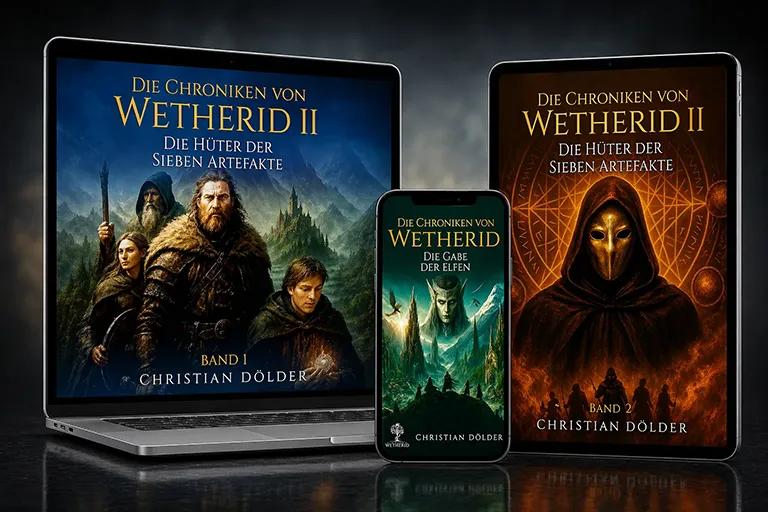
Ready for a new reading adventure? Download the free book samples in PDF or EPUB format and unlock the high-resolution world map and original soundtrack.
Download Free Samples
3. The Kingkiller Chronicle (Patrick Rothfuss)
The Kingkiller Chronicle · 2 of 3 volumes · 2007–2011 · DAW Books ·
Official Website
4.5/5
Rating by Christian Dölder
Focus:
First-Person Fit
Retrospective Frame
Lyrical Prose
Patrick Rothfuss wrote The Name of the Wind in the most direct structural inheritance from Hobb this list contains. Kvothe, former legend and current innkeeper, tells his life story across three days to a scholarly chronicler. The frame narrative echoes Fitz writing his memoirs from Withywoods: a wounded figure reflecting backwards on a life of cost. The register is more lyrical than Hobb's, the tone more romantic in the older literary sense, but the bones are Hobb's bones.
The Hobb Factor
First-person narration across a young life that has already been decided in retrospect. An unbearable loss in the first act — the murder of Kvothe's family — that the rest of the narrative carries rather than resolves. A gift for magical talent that functions as isolation more than triumph. Rothfuss trusts his reader to stay with Kvothe's small humiliations as patiently as Hobb trusts her reader to stay with Fitz's.
How It Differs
The third volume, The Doors of Stone, remains unpublished more than a decade after The Wise Man's Fear. Readers who require completion should calibrate expectations. The two existing volumes are, on their own, one of the finest first-person performances in modern fantasy. Hobb delivered sixteen books over twenty-two years; Rothfuss has delivered two across nearly two decades.
4. The Long Price Quartet (Daniel Abraham)
The Long Price Quartet · 4 volumes (complete) · 2006–2009 · Tor Books ·
Official Website
4.7/5
Rating by Christian Dölder
Focus:
Emotional Devastation
Decades-Long Arc
Character-Intimate
The Long Price Quartet is the character-intimate masterwork of the 2000s. Each of its four volumes is set fifteen years after the one before, following Maati and Otah through four decisive episodes in their lives — from young apprenticeship to the wars and compromises of old age. The total arc covers six decades. The method is Hobb's method: do not skip the years in which nothing dramatic happens, because those are the years in which the characters are formed.
The Hobb Factor
Emotional accumulation across long time. A central friendship — Otah and Maati — that is closer to the Fitz-and-Fool bond than to almost any other male friendship in the genre. Magic (the bound andat, each a sentient concept forced into humanoid form) that functions as private cost rather than public spectacle. A final volume that is, like Assassin's Fate, a sustained reckoning with what has been lost.
How It Differs
Abraham's setting is modelled loosely on East Asian empires rather than medieval Europe, and his prose is more elliptical than Hobb's. Four volumes rather than sixteen, so the commitment is smaller. Abraham has continued in different registers — his later Dagger and the Coin series is a political-financial epic.
5. The Lies of Locke Lamora (Scott Lynch)
Gentleman Bastard Sequence · 3 of 7 projected volumes · from 2006 · Gollancz / Spectra ·
Official Website
4.5/5
Rating by Christian Dölder
Focus:
Male Friendship Bond
Emotional Heist Fantasy
Close-Third POV
The Lies of Locke Lamora opens as a heist novel in a Venice-analogue city state — witty banter, elaborate cons, con artists called the Gentleman Bastards. Halfway through, the book shifts. What remains is one of the most emotionally devastating friendship novels in modern fantasy. Locke and Jean Tannen — the witty thief and the massive brawler — carry the emotional weight that Fitz and the Fool carry across sixteen volumes, compressed into a single book.
The Hobb Factor
A male friendship at the centre of the book rather than at its periphery. Loss that hits harder than any tactical plot reversal should. A prose voice — close third-person, sitting just above Locke's shoulder — that gives the reader an intimacy comparable to Hobb's first-person intimacy. The second volume, Red Seas Under Red Skies, carries the emotional residue forward without letting the reader forget.
How It Differs
Lynch's surface is funnier than Hobb's — the Gentleman Bastards are given to elaborate swearing and con-artist banter. The plotting is tighter, the action sequences sharper. The series is also incomplete: three of seven planned volumes, with the fourth long delayed. Readers who want emotional weight with a different skin should start here.
6. Transformation (Carol Berg)
Rai-Kirah Trilogy · 3 volumes (complete) · 2000–2002 · Roc Books ·
Official Website
4.5/5
Rating by Christian Dölder
Focus:
Traumatized First Person
Master-Servant Dynamic
Hidden Noble Burden
Carol Berg is an absolute dark-horse master of deeply intimate, psychologically intense first-person epic fantasy. Transformation introduces Seyonne, a former warrior and seer of a mystical, broken culture who has been conquered, broken, enslaved, and sold to the volatile, widely despised crown prince of the very empire that demolished his home.
The Hobb Factor
The book operates entirely on the Hobb wavelengths of deep interior suffering and unrecognized duty. Seyonne holds a quiet internal nobility while taking endless emotional and physical beatings for a political apparatus that treats him as trash. The relationship that slowly builds between master and slave mimics the exact psychological progression, friction, and eventual absolute tier of devotion found between Fitz and the Fool.
How It Differs
Berg’s narrative pacing moves faster and more single-mindedly through its internal milestones than Hobb's multi-generational volumes allowed. The prose style is clean and devastatingly transparent, focusing heavily on intense relational dialogues rather than structural landscape descriptions or long domestic interludes.
In Own Cause · Author's Insight
7. Christian Dölder — The Chronicles of Wetherid Sagas
Cycle I: The Legacy of the Elves · Cycle II: The Guardians of the Seven Artefacts (2 volumes) · from 2024 · Verlag Christian Dölder · Multilingual Edition ·
Author Page
4.6/5
Rating by Christian Dölder
Focus:
Character Weight
Patient Loyalty
Retrospective Voice
I introduce my own high-fantasy work distinctly outside the independent comparison parameters. Robin Hobb’s Realm of the Elderlings proved to me that a secondary world doesn't need to choose between vast geopolitical canvas and devastating, intimate internal truth. If you crave that specific slow, quiet cost of loyalty across long volumes, I invite you to read my series.
Emotional Weight Carried by a Single Character
The most emotionally sustained thread across Cycle I runs through the elven ranger Gorathdin. Over the course of The Legacy of the Elves, he loses almost everyone he loves. One scene — Gorathdin running through the dark forest as if he could outrun the grief itself — belongs to the passages readers do not forget quickly. Hobb readers will recognise the register: the refusal to skip past emotional cost, the patience to stay with a character inside his own loss rather than moving the plot on. Fitz spends chapters riding through the snow alone after the death of Burrich. Gorathdin spends chapters running through forests after his own losses. The narrative trust is the same.
Patient Loyalty Over Prophecy
The companions assembled around young Vrenli Hogmaunt — the elven ranger Gorathdin, the dwarf Cumi, the half-elf healer Fendur — are not a fellowship of the chosen. They come together out of circumstance, competing obligations, and debts that pre-exist the current crisis. Each carries loyalty to someone else first: to a homeland, to a family, to a lord who will not acknowledge them. This is the Hobb register of loyalty as a moral burden rather than a narrative convenience. It shapes every decision the group makes, and several of those decisions cost more than any of them expected.
The Frame Narrative as Retrospective Voice
The Legacy of the Elves uses a frame narrative that will feel immediately familiar to Hobb readers. The older Vrenli, years after the events of the book, reads the history to his son. The reader is inside a retrospective voice — someone looking back on what happened and choosing what to emphasise, what to spare, what to confess. This is the same structural device that lets Hobb's first-person narration carry the weight it does: not the voice of the young man living the events, but the voice of the older man who has already paid for them.
The Right Book for Every Farseer Reader
The choice depends on which element of the Farseer Trilogy you most want to follow. Readers who want Hobb's patience at continental scale should start with Elliott. Readers who want Fitz's emotional register compressed into a single wounded servant should read Bujold. Readers who want the first-person intimacy at its purest should read Rothfuss. Readers who want the emotional cost stretched across decades and a decisive male friendship should read Abraham. Readers who want the Fitz-and-Fool bond with a different skin should read Lynch.
Robin Hobb completed the Realm of the Elderlings with Assassin's Fate in 2017. There is no sixteen-volume epilogue waiting. Readers who have finished the full cycle — Farseer, Liveship Traders, Tawny Man, Rain Wild, Fitz and the Fool — are done with Fitz but not done with Hobb's method. The authors above carry that method in different directions.
Each of the series named above stands on its own. None is a substitute for Hobb, and none pretends to be. What they share is the same underlying claim: that epic fantasy can be about the interior life of a single character and still move at the scale of nations, that loyalty is a subject worth taking seriously across thousands of pages, and that a story about quiet cost can carry the weight of any war.
Frequently Asked Questions
What is the best book series similar to the Farseer Trilogy?
Lois McMaster Bujold's The Curse of Chalion is the most frequently recommended match in fan communities. Cazaril — its wounded, middle-aged protagonist who serves a royal house at great personal cost — is the closest companion portrait to FitzChivalry Farseer in modern fantasy. For pure first-person intimacy, Patrick Rothfuss's The Kingkiller Chronicle shares Hobb's confessional register. For deeper emotional devastation across decades, Daniel Abraham's The Long Price Quartet carries the same weight.
Why is Robin Hobb considered so emotionally powerful?
Hobb writes what most epic fantasy refuses to write: the long, quiet cost of loyalty. FitzChivalry Farseer is narrated in first person across sixteen volumes, an unusual scale for that perspective. The reader inhabits one wounded consciousness for thousands of pages. Hobb refuses to let victories arrive cheaply, refuses to let losses be rationalised, and refuses the conventional pacing of heroic fantasy. George R. R. Martin's public praise — that her books are diamonds in a sea of zircons — points to the same quality: the willingness to stay with emotional truth rather than moving on to the next plot beat.
Which of these authors write in the first person like Hobb?
Patrick Rothfuss and Carol Berg are exceptional matches — their protagonists narrate their own lives from a highly intimate perspective, much as Fitz does. Scott Lynch uses close-third rather than first person, but the narrative sits as intimately on Locke Lamora's shoulder as Hobb sits on Fitz's. Kate Elliott, Lois McMaster Bujold and Daniel Abraham write in close-third across rotating viewpoints, not first person, but their emotional register is comparable.
What exactly defines a book like the Farseer Trilogy?
Four elements in combination. First, a protagonist whose interior life is the centre of the book rather than its engine. Second, a patient narrative that refuses to skip the emotional consequences of events. Third, loyalty as a recurring moral burden — to a crown, a family, a bondmate, a friend — carried at real cost. Fourth, a magic or supernatural presence (the Skill, the Wit, the Fool) that is intimate rather than spectacular. Books that share at least two of these carry the Hobb register.
Are the full sixteen books of the Realm of the Elderlings worth reading?
Yes, and the reading order matters. The recommended path is Farseer Trilogy, Liveship Traders Trilogy, Tawny Man Trilogy, Rain Wild Chronicles, Fitz and the Fool Trilogy — publication order. The Liveship Traders detour away from Fitz is initially disorienting but eventually essential; the characters return. The conclusion in Assassin's Fate (2017) is among the most emotionally sustained in the genre. Readers who commit to the full sixteen books report that the final scene rewards every page that came before.