High fantasy refers to stories set entirely in a fictional secondary world – not on our Earth, not in an alternate history, but in a universe with its own geography, its own peoples and its own rules.
The most well-known representatives – Tolkien, Martin, Jordan, Sanderson, Erikson, Hobb, Abercrombie and others – are covered in my top 20 list of the best epic fantasy books. Those looking for titles that appear on no standard list will find ten discoveries in my article Books Like Lord of the Rings – 10 Hidden Gems.
This list occupies the gap in between. Ten series that experienced readers may recognise, but that regularly go missing from major recommendation sites. Each one is set in a secondary world, offers deep worldbuilding and is aimed at adult readers. I have been reading and writing in the genre for over twenty years. This is my selection.
1. The Riftwar Cycle (Raymond E. Feist)
30+ volumes · from 1982 · Bantam / HarperVoyager ·
Official Website
Raymond E. Feist began in 1982 with Magician, a novel about an orphan boy who becomes a wizard. What started as a classic hero's journey grew over three decades into a universe spanning two planets and filling more than thirty books. The Riftwar Cycle connects the medieval world of Midkemia with Kelewan, a civilisation inspired by Asian cultures – linked through magical rifts in space.
Feist's strength lies in breadth. Across the various series within the cycle, the protagonists, conflicts and tone shift constantly. The Riftwar Saga itself is classic coming-of-age fantasy. The Empire Trilogy – written with Janny Wurts – shifts the perspective to the opposing side and delivers political intrigue at a level that anticipated Martin. The later series deal with wars, trade empires and divine conflicts.
The weakness lies in consistency. Not all thirty volumes maintain the same standard. But the first two trilogies – the Riftwar Saga and the Empire Trilogy – belong to the bedrock of high fantasy and are too rarely mentioned alongside Tolkien and Jordan.
2. The Drenai Saga (David Gemmell)
11 volumes · from 1984 · Orbit / Del Rey ·
Wikipedia
David Gemmell is the author soldiers read. His Drenai Saga – named after the Drenai people – tells no linear story, but rather a mosaic of standalone novels spread across centuries in the same world. The figure that connects them is Druss – a warrior whose axe and reputation outlast legends.
Gemmell writes short, direct and without embellishment. His books are not thousand-page tomes. Most run between three and four hundred pages. What grips the reader is the concentration: each novel places a siege, a battle, a decision at its centre and tells it with an immediacy that larger series often lack. His heroes are not shining figures – they are people who are too old, too tired, too damaged, and fight anyway.
Gemmell died in 2006. His work never achieved a major commercial breakthrough in the German-speaking world, although in England the David Gemmell Award for Fantasy was named after him. If you want fantasy that feels like a war camp and not a seminar, this is where to look.
 Epic High Fantasy
The Chronicles of Wetherid
Ready for a new reading adventure? Download the free book samples in PDF or EPUB format and unlock the high-resolution world map and original soundtrack.
Download Free Samples
3. The Lies of Locke Lamora (Scott Lynch)
Gentleman Bastards · 3 of 7 planned volumes · from 2006 · Gollancz / Bantam ·
Official Website
Scott Lynch wrote a series that feels like a heist film set in a Venetian secondary world. Locke Lamora is an orphan who becomes the most gifted con artist in his city. He does not rob peasants – he robs the nobility, using false identities and elaborately staged schemes prepared over weeks. Alongside this exists an underworld with its own laws, a mage order with political power and ruins of an older civilisation whose origin nobody knows.
Lynch's strength lies in dialogue and in the balance between humour and brutality. The characters talk sharp, the twists hit hard and the emotional blows arrive without warning. The city of Camorr is one of the most vivid secondary-world cities in fantasy – comparable to Lankhmar, Ankh-Morpork or King's Landing.
The weakness is well known: the pace of publication. Six years passed between volumes two and three. Volume four has been announced for over a decade. Those who can live with that will find some of the most entertaining fantasy novels of the last twenty years.
4. The Coldfire Trilogy (C.S. Friedman)
3 volumes · 1991–1995 · DAW Books ·
Wikipedia
C.S. Friedman created a work with the Coldfire Trilogy that defies easy genre classification. The world of Erna was colonised centuries ago by humans whose starships crashed. The technology was lost. What remained is a force called the Fae – an energy that responds to human emotions and can transform thoughts into physical reality. Civilisation on Erna has regressed to a medieval society where the Fae functions like magic but follows the laws of nature.
The trilogy tells the story of a forced alliance between a priest and an immortal sorcerer who sacrificed his humanity centuries ago. Friedman treats questions of faith, sacrifice and moral compromise with a seriousness that is rare in the genre. Her magic system – based on scientific principles – is among the most thoroughly conceived in all of fantasy.
In the English-speaking world, the trilogy has a devoted readership that regularly names it one of the most underrated fantasy series. A hidden gem that deserves far more attention than it receives.
5. The Chronicles of Amber (Roger Zelazny)
10 volumes · 1970–1991 · Avon / EOS ·
Wikipedia
Roger Zelazny was an author who fused science fiction and fantasy before the concept had a name. The Chronicles of Amber rests on a single premise: there is one true world – Amber – and everything else, including our Earth, is merely a shadow projection of it. The princes of Amber can walk through these shadows and shape realities to their will.
The first pentalogy – told from the perspective of Prince Corwin – reads like a thriller. Corwin awakens without memory on Earth, reconstructs his identity and throws himself into a succession war among nine siblings. Zelazny writes lean and fast. His prose has more in common with Chandler than with Tolkien. The intrigues among the princes of Amber are complex, the twists unpredictable and the narrative perspective consistently subjective.
The second pentalogy – from the viewpoint of Corwin's son Merlin – is weaker, but the first five volumes rank among the most original works in fantasy. Zelazny created with Amber a concept whose philosophical depth has remained unique.
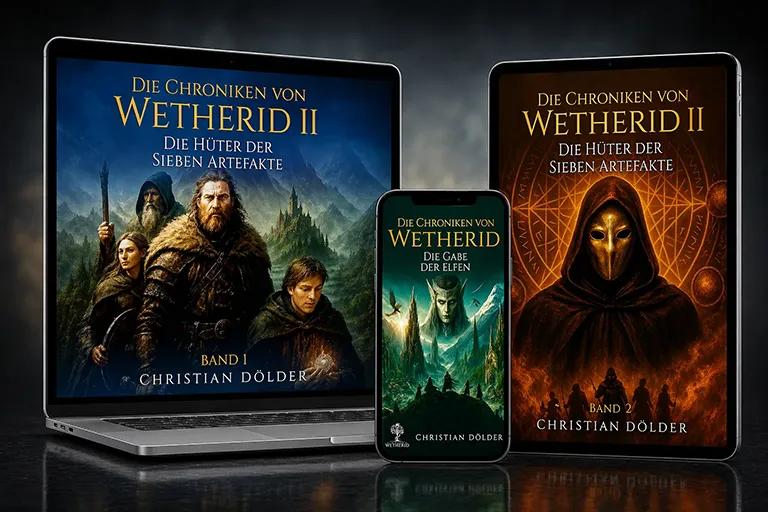
6. The Chronicles of Wetherid (Christian Dölder)
Cycle I: The Legacy of the Elves (679 pp.) · Cycle II: The Guardians of the Seven Artefacts (2 volumes) · from 2024 · German, English, French, Spanish ·
Author Page
Wetherid is a secondary world with over 140 characters, 70 locations and 21 peoples. The first cycle – The Legacy of the Elves – tells a classic fellowship quest: grey dwarves, mist elves, ogres and humans form an alliance against an existential threat. The second cycle – The Guardians of the Seven Artefacts – shifts the tone. Instead of a fellowship quest, political intrigue, broken alliances and moral grey areas dominate.
The style differs from most entries on this list: functional, hard prose without pathos and without metaphor. Magic exists, but it is rare and dangerous. Fights end quickly and without glamour. The world is documented in a wiki with over 200 entries, two world maps and an interactive story map.
The series is aimed at readers looking for secondary worlds with their own identity – not Tolkien copies, not grimdark exaggeration, but a world that writes its own rules and enforces them consistently.
7. The Deryni Novels (Katherine Kurtz)
17 volumes · from 1970 · Ballantine / Ace ·
Wikipedia
Katherine Kurtz began in 1970 – six years after Tolkien – with a fantasy series that took an entirely different path. Her Deryni world is not based on mythology but on the history of medieval Europe. The Deryni are a people with magical abilities living in a society modelled on the Church of the 12th century. Magic is not spectacular – it is subtle, political and dangerous.
Kurtz's strength lies in historical texture. Her world has councils, church politics, feudal systems and coronation ceremonies described in such detail that they could pass as historical novels. The conflicts revolve not around dark lords but around racism, religious persecution and the question of how power is legitimised.
The series never achieved the popularity of Tolkien or Jordan, but is cited in academic circles as one of the first works to combine high fantasy with historical depth. For readers who appreciate Guy Gavriel Kay, Kurtz is the logical predecessor.
8. Wars of Light and Shadow (Janny Wurts)
11 volumes · 1993–2023 · HarperVoyager ·
Official Website
Janny Wurts is known as the co-author of the Empire Trilogy with Raymond E. Feist. Her solo work – the Wars of Light and Shadow – is far less widely read and far more ambitious. The series tells the conflict between two half-brothers – Arithon and Lysaer – who are made enemies by prophecy, although neither of them is evil.
Wurts writes dense and demanding prose. It requires attention but rewards it with worldbuilding that ranks among the deepest in the genre. The magic follows strict rules. The politics are complex. The moral questions – freedom versus order, individual versus collective – are not answered but negotiated across eleven volumes.
The series was completed in 2023 with the eleventh volume. It has never received a German translation, which given its quality ranks among the greatest oversights of German-language fantasy publishers.
9. Chronicle of the Unhewn Throne (Brian Staveley)
3 volumes + 1 prequel · 2014–2016 · Tor Books ·
Official Website
Brian Staveley tells the story of three siblings – children of an assassinated emperor – who grow up in different parts of the world and each attempt in their own way to save their father's empire. One is a monk in a remote monastery. One is a politician in the capital. One is a soldier on the frontier.
The strength lies in the structure. Three perspectives, three genres within a single book: philosophical coming-of-age novel, political thriller and military fantasy. Staveley switches between these registers with a confidence that surprises for a debut. The world is detailed – its own mythology, ancient peoples, an empire on the brink of collapse – but Staveley explains it in passing, without interrupting the narrative flow.
The trilogy is complete. It delivers in three volumes what other series fail to achieve in ten: a full arc with beginning, middle and end.
10. The Death Gate Cycle (Weis & Hickman)
7 volumes · 1990–1994 · Bantam Spectra ·
Wikipedia
Margaret Weis and Tracy Hickman are known as the Dragonlance authors. Their most ambitious work is a different one: The Death Gate Cycle is set in a world that was split into four elemental realms after a magical catastrophe – Air, Fire, Water and Stone. Each volume takes place in one of these realms before the plotlines converge.
The concept is unique in high fantasy. Each realm has its own physics, its own peoples and its own conflicts. The Air realm consists of floating islands. The Fire realm is a cavern world beneath the surface. In the background stands the conflict between two ancient races – the Sartan and the Patryn – whose war caused the sundering of the world.
The series is more compact than Dragonlance, intellectually more demanding and structurally more experimental. It deserves a place alongside the great names of the genre and too rarely receives one.
Frequently Asked Questions
Why are Tolkien, Martin and Sanderson missing from this list?
Because they appear on my top 20 list of the best epic fantasy books, alongside Jordan, Erikson, Hobb, Abercrombie and others. This page deliberately focuses on series that are missing from the standard lists.
What distinguishes high fantasy from epic fantasy?
High fantasy is defined by its setting: an entirely fictional secondary world. Epic fantasy is defined by its scope: large conflicts, multiple perspectives, several volumes. Most works across all three of my lists are both – but the distinction helps with classification. The Chronicles of Amber, for example, are high fantasy but not epic in the classical sense. Druss the Legend is heroic fantasy in a secondary world but not a thousand-page saga.
Are all of these series complete?
The Riftwar Cycle, the Drenai Saga, the Chronicles of Amber, the Coldfire Trilogy, the Deryni novels, Wars of Light and Shadow, Chronicle of the Unhewn Throne and The Death Gate Cycle are all complete. The Gentleman Bastards series by Scott Lynch is still ongoing – three of seven planned volumes have been published. The Chronicles of Wetherid are in active development, with the first cycle finished and the second cycle currently being released.
Where can I find more recommendations?
My top 20 list covers the major names of the genre. My article Books Like Lord of the Rings names ten genuine hidden gems that appear on no standard site. Together, the three lists cover over forty series.