Daniel Abraham published The Dragon's Path in 2011 and closed the five-volume Dagger and the Coin with The Spider's War in 2016. The series did something most fantasy avoids. It took money seriously. Cithrin bel Sarcour, a smuggled orphan who rises to run a branch of the Medean bank in Porte Oliva, is one of the few protagonists in modern epic fantasy who wields an actual budget as a weapon. The rise of the neurotic tyrant Geder Palliako, manipulated by a cult of Spider priests whose speech compels belief, is one of the most unsettling political arcs the genre has produced.
Abraham demonstrated that fantasy could be about institutional collapse and economic power. What follows is a curated comparison of six series that take a similar architectural approach to fiction. My own work appears separately afterward and is clearly labeled as such.
What Dagger and the Coin Readers Are Actually Looking For
Most epic fantasy treats money as decoration. Gold coins, merchant guilds, trade routes — scenery rather than mechanism. Abraham refused that convention. The Medean bank in Porte Oliva operates as a tactical engine across five volumes: Cithrin's interest rates reshape military campaigns, her loans buy cities, her foreclosures decide wars. The magic and the dragons exist, but they sit behind the economy, not in front of it.
The other inversion is the villain. Geder Palliako is not a dark lord. He is a nervous reader, easily embarrassed, desperate for approval, who happens to be taken up by a religious cult that amplifies every insecurity he carries. The genocide of the Timzinae is carried out by someone the reader understood three books earlier. That is a specific kind of political horror, and it is rare in the genre.
So readers looking for books like The Dagger and the Coin are actually looking for: political complexity across rotating viewpoints rather than a single hero's journey, moral ambiguity where the worst actors are comprehensible, non-combat power — banking, law, diplomacy, priestcraft — treated as seriously as swordplay, tyranny that arises from weakness rather than strength, and consequences that accumulate slowly across multiple volumes.
1. The First Law (Joe Abercrombie)
The First Law world · 3 volumes + 3 standalones + Age of Madness trilogy · from 2006 · Gollancz ·
Official Website
4.8/5
Personal rating by Christian Dölder · Author & Reader
Focus:
Political Multi-POV
Moral Grey
Cynical Register
Joe Abercrombie is the most frequently named companion to Daniel Abraham in fan recommendations, and the reason is structural. The First Law opens as conventional epic fantasy and systematically dismantles the conventions from the inside. Logen Ninefingers, the warrior with a reputation that precedes him. Sand dan Glokta, the crippled Inquisitor who was himself tortured. Jezal dan Luthar, the vain noble officer who is gradually weaponised by forces he does not understand. Bayaz, the apparently Gandalfian wise mage who turns out to be the most ruthless political operator on the continent.
The Abraham Factor
Rotating viewpoints used to show political collapse from multiple angles simultaneously. Moral ambiguity as a structural principle rather than a character flaw. The Union, the Northmen and Gurkhul function as faction blocs whose interests interlock in ways that nobody in the books fully controls. Bayaz is Abercrombie's Geder Palliako, in a different shape: the ostensible ally whose long-term agenda is more destructive than the declared enemies.
How It Differs
Abercrombie is funnier than Abraham. His prose leans on black comedy and bitter one-liners where Abraham's prose stays clinical. Swords decide more in First Law than letters of credit do. The Age of Madness trilogy brings industrial revolution to the same world, but Abercrombie's economic imagination never quite reaches the precision of Abraham's banking scenes. For readers who want the political density with more open violence, Abercrombie is the starting point.
2. The Traitor Baru Cormorant (Seth Dickinson)
The Masquerade · 3 of 4 projected volumes · from 2015 · Tor Books ·
Official Website
4.7/5
Personal rating by Christian Dölder · Author & Reader
Focus:
Closest Cithrin Cousin
Economic Sabotage
Colonial Politics
Seth Dickinson wrote The Traitor Baru Cormorant as a direct interrogation of what Daniel Abraham began exploring with Cithrin. Baru, a child of a colonised island culture, is trained by the Masquerade empire as an accountant and deployed to administer a distant province. Her secret plan, held across four books, is to destroy the empire from inside its own financial system. The surface is administrative fantasy. The interior is revolutionary betrayal on a scale the genre rarely attempts.
The Abraham Factor
Finance as political weapon, rendered at page-by-page technical resolution. Baru's manipulation of the Aurdwynn tax system is as satisfying to read as Cithrin's loan contracts in Porte Oliva, and for the same reason: the author has done the work. Moral ambiguity that refuses to resolve — Baru is complicit in the atrocities she intends to reverse, and the books do not let her off that hook. Multiple viewpoints across later volumes expand the faction map in the Abraham manner.
How It Differs
Dickinson writes more angrily than Abraham. The Masquerade empire is explicitly colonial, racist and homophobic, and Baru's suffering is a structural component of the narrative rather than a background note. The prose is denser and more interior. The fourth volume is still pending. Readers who want Abraham's economic rigour sharpened into a direct political attack should start here.
3. The Folding Knife (K. J. Parker)
Standalone novel · 2010 · Orbit Books ·
About the Author
4.6/5
Personal rating by Christian Dölder · Author & Reader
Focus:
Pure Banking Fantasy
Standalone
Cynical Masterwork
K. J. Parker — the pen name of British author Tom Holt — has spent a career writing the fantasy nobody else will write. The Folding Knife is a single-volume novel about Basso the Magnificent, First Citizen of the Vesani Republic, who builds an economic empire by understanding debt better than his rivals and loses it for reasons no army could have caused. It is the purest distillation in fantasy of Abraham's thesis: that finance is a more decisive weapon than steel.
The Abraham Factor
Banking treated with technical seriousness — interest rates, debt structures, currency manipulation as plot engines. A protagonist who is simultaneously brilliant and morally compromised, operating at the edge of what the political system will tolerate. A narrative that refuses easy consolation. Parker's cynicism matches Abraham's, and where Abraham spreads the argument across five volumes, Parker compresses it into one tight book. Readers who want Abraham's method at its most concentrated should read this first.
How It Differs
Parker's fantasy is lower-magic than Abraham's — there are no spider priests, no dragons, nothing supernatural at all in many of his books. The secondary world is Mediterranean-Renaissance in feel rather than pseudo-medieval. Parker's output is vast and uneven. Readers who like The Folding Knife should try Sharps and The Company next; readers who want longer arcs should read the Engineer Trilogy.
 Epic High Fantasy
The Chronicles of Wetherid
Ready for a new reading adventure? Download the free book samples in PDF or EPUB format and unlock the high-resolution world map and original soundtrack.
Download Free Samples
4. Malazan Book of the Fallen (Steven Erikson)
Malazan Book of the Fallen · 10 volumes (complete) · 1999–2011 · Bantam Press / Tor Books ·
Official Website
4.7/5
Personal rating by Christian Dölder · Author & Reader
Focus:
Maximum Faction Complexity
Military Fantasy
Active Pantheon
Steven Erikson's ten-volume Malazan Book of the Fallen pushes the multi-faction political method to its limit. The Malazan Empire, the rebelling Seven Cities, the T'lan Imass, the Tiste Andii, the Crippled God, the Bridgeburners, and a dozen other factions pursue interlocking agendas across more than ten thousand pages. No viewpoint controls the full picture, and the books do not provide the reader with an authoritative perspective. Erikson trained as an anthropologist. It shows.
The Abraham Factor
Abraham's five factions in Dagger and the Coin — Antea, Birancour, Sarakal, Elassae, the Free Cities — become Erikson's thirty factions, scaled up by an order of magnitude. The Bridgeburners, an elite military unit operating inside an empire whose leadership does not entirely trust them, sit in the same political space as Marcus Wester's mercenary company. Non-combat power matters: the Empire's bureaucracy, its shipping lanes, its diplomatic networks are load-bearing in the plot.
How It Differs
Erikson refuses to explain. Gardens of the Moon throws the reader into an ongoing war between powers none of whom are introduced, and the reader must orient from context across several volumes. The scope is larger than Abraham's, the prose denser, and the philosophical register more ambitious. The magic is omnipresent rather than background. Abraham readers who want political complexity at continental scale — and who are willing to work for it — will find no superior model.
5. The Broken Earth Trilogy (N. K. Jemisin)
The Broken Earth · 3 volumes (complete) · 2015–2017 · Orbit Books ·
Official Website
4.8/5
Personal rating by Christian Dölder · Author & Reader
Focus:
Structural Oppression
Earth-Magic System
Hugo Hat-Trick
N. K. Jemisin won the Hugo Award for Best Novel three years in a row with The Broken Earth Trilogy, the first author to achieve this. The series follows three orogenes — people with the inborn power to manipulate tectonic energy, a power their society both exploits and exterminates — across the collapse of a continent. The political thesis is that institutions weaponise hated minorities to maintain themselves, and that collapse follows when the weaponisation becomes unsustainable.
The Abraham Factor
Political power analysed at its foundations rather than its surface. The Fulcrum, which trains and breaks orogenes, is an institution the Spider priests of Dagger and the Coin would recognise: a religious-administrative apparatus that turns individual capacity into state power. Rotating viewpoints across three narrative strands echo Abraham's method. Jemisin refuses the consolation of a clean villain just as Abraham does with Geder.
How It Differs
Jemisin's narrative is second-person for significant portions — the reader is directly addressed as one of the protagonists, a technique that defamiliarises the trauma at the centre of the story. The setting is post-apocalyptic and geologically unstable rather than medieval-mercantile. The trilogy is shorter than Dagger and the Coin and more structurally experimental. For Abraham readers who want political seriousness pushed into formally ambitious territory, this is the landing point.
6. The Dandelion Dynasty (Ken Liu)
The Dandelion Dynasty · 4 volumes (complete) · 2015–2022 · Saga Press ·
Official Website
4.6/5
Personal rating by Christian Dölder · Author & Reader
Focus:
Statecraft & Engineering
Multi-POV Epic
Rebellion to Empire
Ken Liu's monumental silkpunk masterpiece, starting with The Grace of Kings, chronicles an expansive world of dynastic transition, detailing the logistics of rebellion, the formation of legal frameworks, and the complex engineering of an empire. Instead of relying on traditional brute mystical force, the narrative revolves around statecraft, mechanical inventiveness, and military engineering.
The Abraham Factor
An intense focus on non-combat power structures, diplomacy, and bureaucratic mechanics. Liu charts how shifting alliances, institutional decay, and structural adaptations alter the fate of an entire continent over generations, echoing Abraham's clinical focus on how systemic transformations actually unfold.
How It Differs
The series utilizes "silkpunk" technology—including mechanical airships and submarines—and introduces a distinct mythological structure rooted in classical Chinese epics. It moves at an evolutionary clip through societal developments, offering a broader macro-view of history compared to Abraham's micro-resolution banking networks.
On a Personal Note
Christian Dölder — How Wetherid Addresses the Appetite for Institutional Decay
Cycle II: The Guardians of the Seven Artifacts (2 volumes available) · from 2024 · Verlag Christian Dölder · Multilingual Edition ·
Author Page
4.6/5
Personal rating by Christian Dölder · Author & Reader
Focus:
Political Collapse
Fragile Alliances
Multi-Continent Ensemble
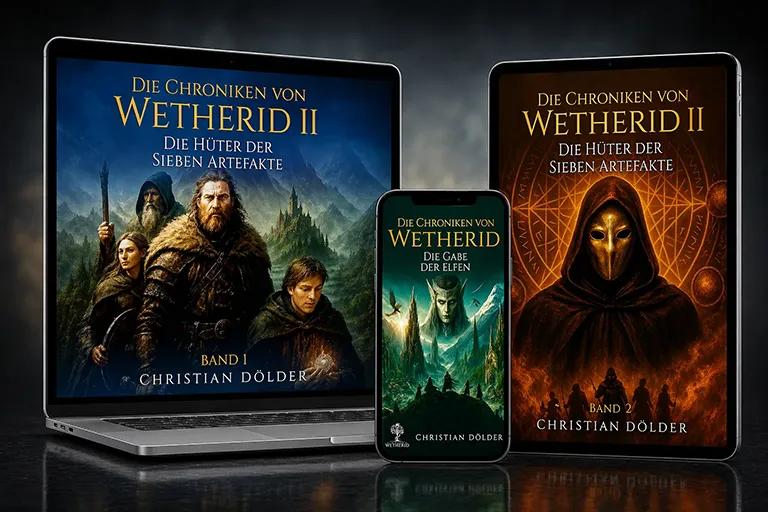
As an author, I am deeply inspired by the structural bravery of Daniel Abraham's work. In my own writing, particularly from the second cycle onwards, I attempt to capture that exact same register: where the real tension does not come from a magical artifact alone, but from the fracturing of fragile political bodies under pressure. Here is a transparent look at how The Chronicles of Wetherid treats these same motifs.
Political Collapse from Within
The human city of Astinhod begins The Guardians of the Seven Artifacts at the moment its political order breaks. The Queen is dead. What follows is not open warfare but what Abraham readers know to watch for: closed council meetings, whispered blackmail, murder disguised as misadventure. Lady Merdiva manipulates the hesitant Lord Eryndor for leverage she does not declare. Aldion and Belmarr pursue competing claims on the council with methods that would not survive daylight. Every dialogue carries a secondary meaning. Every alliance is provisional. This is the Astinhod equivalent of Camnipol in The Tyrant's Law — a political centre rotting in slow motion while the characters inside it pretend otherwise.
Alliances of Convenience, Not Virtue
The opposing side in the Guardians cycle is not a unified dark force. It is a fragile alliance of convenience held together by coercion, mistrust, and the influence of the demon Xaroth. The Orc shaman Gorzod Graywing commands uneasily. The Grey Dwarves under Brumir Ironfist pursue their own interests regardless of the larger threat. The Undead under Azrakel obey out of fear, not loyalty. Prince Sylvian of the Mist Elves blackmails High Commander Elroth of the Glorious Elves to extract political concessions. This is the same structural method Abraham uses with the Spider priests and their Antean host: the real danger is not the raw power of the antagonist, but the leverage that unfreezes institutions that should have resisted.
Ensemble Perspectives Across Continents
The Guardians cycle unfolds through numerous parallel storylines on different continents. The political collapse in Astinhod runs parallel to the consolidation of power in Fallgar, the hesitant response of the elven realms, and the movement of the guardians themselves toward the Glorious Valley. The narrative method is Abraham's rotating-viewpoint method, translated into a larger geographic frame. Readers who valued the way The Dagger and the Coin cut between Cithrin's bank, Marcus's campaigns, Geder's court and Clara's drawing room will find the same structural instinct here, applied to twenty-one peoples across more than forty named locations.
The Right Book for Every Dagger and the Coin Reader
The choice depends on which element of Abraham's series you most want to follow. Readers who want the political density with more open violence should start with Abercrombie. Readers who want the economic warfare sharpened into direct revolutionary action should read Dickinson. Readers who want Abraham's method compressed into a single standalone novel should pick up Parker's The Folding Knife. Readers who want the faction complexity pushed to its continental maximum should commit to Erikson. Readers who want the political register pushed into formally ambitious territory should read Jemisin.
Daniel Abraham closed The Dagger and the Coin with The Spider's War in 2016 and has moved on to other projects. Readers who want more Abraham directly should go backwards to the character-intimate Long Price Quartet or sideways to The Expanse, the science fiction series he co-writes with Ty Franck as James S. A. Corey. Readers who want the same political seriousness applied to new worlds should pick any of the authors above.
Each of the series named above stands on its own. None is a substitute for Abraham, and none pretends to be. What they share is the same underlying claim: that epic fantasy can carry the weight of real political analysis, that money and institutions are more interesting than swords and coronations, and that the worst disasters in a political system usually arise from the inside rather than from outside invasion.
Frequently Asked Questions
What is the best book series similar to The Dagger and the Coin?
Seth Dickinson's The Traitor Baru Cormorant is the closest single match. Baru — a colonial accountant who weaponises finance against her own empire — is the clearest structural cousin to Cithrin bel Sarcour in modern fantasy. For the gritty multi-POV political register with faction collapse, Joe Abercrombie's The First Law is the most widely recommended pairing. For a standalone meditation on banking and power, K. J. Parker's The Folding Knife is the single novel closest in spirit to Abraham's entire series.
What makes The Dagger and the Coin different from most epic fantasy?
Abraham built the series around a thesis most fantasy avoids: that money is as decisive a weapon as steel. Cithrin's branch bank in Porte Oliva operates as a tactical engine throughout the five volumes. Interest rates, loans and trade routes drive the plot as much as armies do. The antagonist Geder Palliako becomes a genocidal tyrant not through strength but through neurotic weakness wielded by a religious cult. The series refuses the usual fantasy consolations — the chosen hero, the clean battle, the redemptive ending — in favour of a slower, more cynical argument about how political collapse actually happens.
Which of these series feature banking or economic fantasy specifically?
K. J. Parker's The Folding Knife is the purest example: a novel about a banker who becomes First Citizen of a mercantile republic and builds, then destroys, an economic empire. Seth Dickinson's The Traitor Baru Cormorant uses finance as direct political sabotage. Beyond these two, economic fantasy remains a niche within the genre. Abraham, Parker and Dickinson together form the small canon of modern fantasy that takes money seriously as a plot engine.
What exactly defines a book like The Dagger and the Coin?
Four elements in combination. First, political complexity that unfolds across rotating viewpoints rather than through a single hero. Second, moral ambiguity — the worst actors are comprehensible and the best actors are compromised. Third, non-combat power taken seriously — banking, law, priestcraft, diplomacy treated with the same weight fantasy usually reserves for swordplay. Fourth, consequences that accumulate slowly across multiple volumes rather than resolving in single climaxes. Books that share at least two of these elements carry the Abraham political register.
Is The Dagger and the Coin a good entry point to Daniel Abraham's work?
Yes. The Dragon's Path is accessible and the series is complete across five volumes, which is rare in modern epic fantasy. Readers who enjoy the political register and want more character-intimate work from Abraham should continue with his earlier Long Price Quartet — four volumes, each set fifteen years after the previous, following the same characters across six decades. Readers seeking his science fiction collaboration with Ty Franck should pick up The Expanse, written as James S. A. Corey.