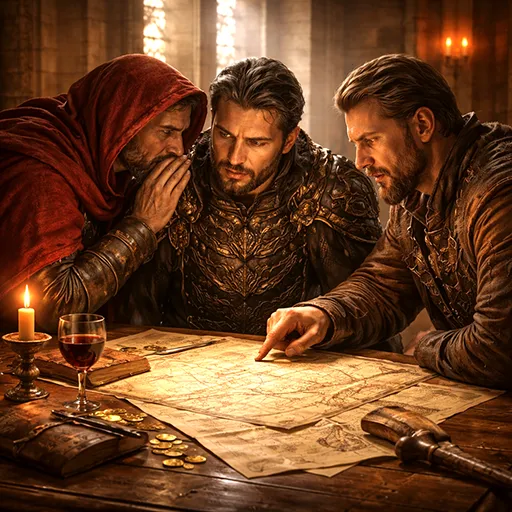
Intrigue is the opposite of heroism. The hero draws the sword and decides everything in a single stroke. The schemer lays a hand on the king's arm and decides over generations. Political fantasy tells no story of a battle against a monster, but of a battle against the ally who will be tomorrow's traitor. It needs no armies. It needs a council chamber, half a dozen figures with hidden agendas, and the certainty that every decision sets off a chain no one can control anymore.
This article presents four models of how grand political intrigue works in epic fantasy — three internationally established works and one German-language saga that serves all four patterns in parallel. The focus lies on the fourth series, because it is the heart of my own work as an author and because it contains more council chambers, fallen heroes and disintegrating alliances than German-language high fantasy has produced in the past twenty years.
Three models of political intrigue in fantasy
Each of the following works represents a distinct type of political intrigue. Anyone who wants to understand how differently scheming can function will find three poles here — and then the saga that attempts to hold all three simultaneously.
1. A Song of Ice and Fire (George R.R. Martin)
5 published volumes to date · since 1996 · Bantam (US) / HarperVoyager (UK) ·
Official Website
4.9/5
Rating by Christian Dölder
Intrigue model:
Machiavellianism
Dynastic War
Honour as Weakness
The Martin model
Intrigue as a study of failed justice. Those who act honourably die. Those who survive have paid a price no hero's tale would justify. The throne is not a goal but a funnel that consumes everything drawn near it.
Martin recalibrated the genre. Before A Song of Ice and Fire, political fantasy was the trim around an essentially heroic plot. After Martin, political fantasy is the plot itself. The first thing he kills is the protagonist whom every classical fantasy reader would have considered untouchable. Eddard Stark is honourable, capable, the rightful advisor to the king — and he is beheaded on the executioner's block because he treats honour as a virtue rather than a weakness.
How the intrigue works: The Seven Kingdoms nominally hold together, but every great family maintains its own agenda, its own memory, its own reckoning. Cersei Lannister guards her incestuous secret. Littlefinger drives up the price of chaos because he profits from chaos. Varys plays for a faction whose very existence the others do not suspect. Every actor operates with an informational advantage another actor does not have. This asymmetry is the power source of every single scene.
What Martin teaches: Anyone who wants to write political fantasy must sacrifice the figure of honour at the start of the work to condition the reader. They must learn that competence does not protect, that virtue does not win, and that any vote in a small council can be a death sentence in disguise. Once they have understood that, they read every subsequent conversation as a game.
Weakness of the model: With over a hundred POV figures, Martin risks losing the thread. Volumes four and five fray. This is the price of Machiavellianism: it does not scale without limit.
2. The First Law (Joe Abercrombie)
Original trilogy (2006–2008) + follow-up novels · Gollancz (UK) / Orbit (US) ·
Official Website
4.8/5
Rating by Christian Dölder
Intrigue model:
Shadow War
Moral Grey Zone
Principles for Sale
The Abercrombie model
Intrigue as a study of people negotiating their own principles. Not because they are weak, but because the situation leaves no alternative. The traitor knows he is a traitor and still cannot prevent it.
Abercrombie works tighter than Martin. Fewer POV figures, but each one plumbed to the psychological marrow. Glokta — once a celebrated cavalry officer, now a crippled torturer in the service of the Inquisition — is the central figure: a man who knows from personal experience the pain he inflicts on others. He asks no question he could not already answer himself. Every scene with him is a study in moral erosion.
How the intrigue works: Behind all visible political forces stands Bayaz, the First of the Magi, who has steered the fortunes of the Union for centuries. Bayaz is no advisor — he is the actual regent. The kings who appear to rule are placeholders. This structure creates a double political layer: the visible politics of the court and the hidden politics of the Magus. Every character who tries to act politically acts, unknowingly, within a framework Bayaz established centuries ago.
The fallen hero: Abercrombie's specialty is figures who were once heroes and are now something else. Logen Ninefingers, known as "the Bloody-Nine," tries to be no longer a killer — and fails every time it matters. Jezal dan Luthar, vain young aristocrat, is made king and understands only too late that he is another man's puppet. These arcs form the emotional spine of the series.
What Abercrombie teaches: Intrigue requires no armies but a single room where two figures sit, and the certainty that one of them will have betrayed the other by the end of the conversation. The only question is which one.
3. The Goblin Emperor (Katherine Addison)
Standalone novel 2014, expanded by follow-up works · Tor Books ·
Official Website
4.7/5
Rating by Christian Dölder
Intrigue model:
Courtly Microclimate
Etiquette as Weapon
Intrigue Without War
The Addison model
Intrigue as a study of power without violence. No one dies in a sword fight. The deadly weapons are the wrong form of address, the refused invitation, the overlooked difference in rank. Whoever does not master protocol loses.
Addison proves that political fantasy can do without battles, armies or hero quests. The Goblin Emperor is a single chamber play: Maia, half-goblin fourth son of a deceased emperor, inherits the throne after an airship attack kills his father and his three half-brothers — a throne for which no one has prepared him. He does not know the rituals, the forms of address, the families, the history. He does not even know he is entitled to a bodyguard.
How the intrigue works: Every figure at court has a formal rank, a formal form of address, a formal order of entry. Violating these forms is a political act. A minister who addresses the emperor incorrectly signals the emperor's inferiority. A courtier who secretly instructs Maia makes him a debtor. Maia must survive this web without betraying the relatives who have mistreated him his entire life, and without alienating the advisors who despise him.
What Addison teaches: Intrigue does not require murders. It requires rules so finely woven that their transgression is already a statement. When the courtier arrives one minute late, he is saying something to the emperor. This linguistic fabric carries an entire novel. A lesson in how little action political fantasy needs when the worldbuilding is precise enough.
Heart of the Author's Work
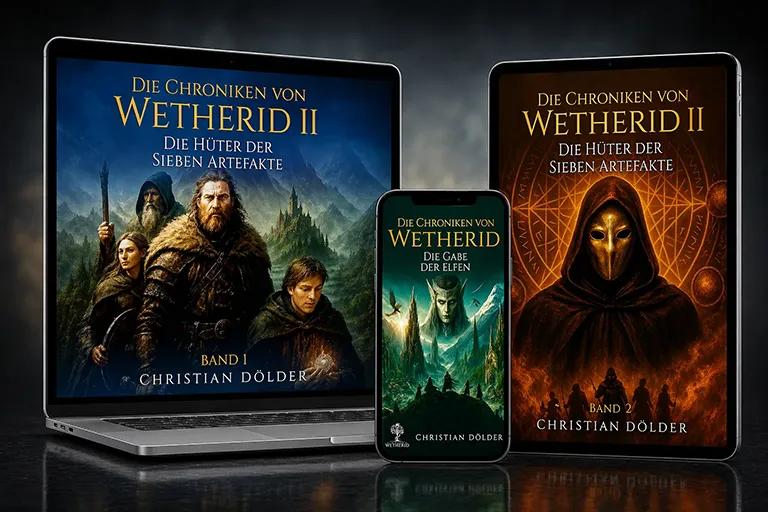
4. The Chronicles of Wetherid II: The Guardians of the Seven Artifacts (Christian Dölder)
Volume 1 (April 2025), Volume 2 (December 2025), Volume 3 (28 July 2026) · Verlag Christian Dölder · English, French, Spanish, German ·
Author Page
4.6/5
Rating by Christian Dölder
Focus:
Four Parallel Storylines
Transactional Alliances
Betrayal as Structure
The following four sections are the core of this article. They show how political intrigue in The Guardians of the Seven Artifacts runs across four theatres simultaneously, how each theatre operates its own intrigue model, and how the four strands converge in the end. Four council chambers, four traitors, four reckonings. The heroes are absent. The world falls apart without them.
4Intrigue Theatres
140+Named Characters
9Antagonists with Own Agenda
21+Peoples
Theatre I – The Capital
The Council of Astinhod: Machiavellianism at Full Force
In Astinhod, capital of the Great Realm of Wetherid, the entire leadership of the state falls within days: Queen Lythinda is murdered by an arrow in the throne hall, Commander Arkondir poisoned, the lady-in-waiting Leandra — the poisoner who intended to confess the next morning — silenced. The Regency Council convenes and fragments at once into three factions.
- The Legitimists
- High Chancellor Darion Althoras, Duke Belmarr, Treasurer Ahnwen. Goal: stability, defence of the throne claim of Gorathdin, the absent husband of the dead queen.
- The Power Seekers
- Grand Duke Aldion as throne aspirant, Count Rohedan as opportunist. Aldion instrumentalises racist prejudice against the half-elf Gorathdin.
- The Uncommitted
- Margravine Seradia with ambitions of her own, Chamberlain Eryndor as a vote open to the highest bidder, old Count Asteran as the conscience of the council.
- The Hidden Third
- Baroness Merdiva, formally on Aldion's side but secretly in the service of the Governor of Irkaar, who in truth triggered the chain of murders and who is himself under Xaroth's influence.
Merdiva stages a drug scandal against Seradia by bribing the petty thief Kaaron to deliver incriminating false testimony before the council. Master Drobal exposes the witness as a criminal — but the reputation is damaged, and Seradia must withdraw her candidacy. In parallel, Merdiva seduces the chamberlain Eryndor with gold, sexual manipulation and forged promises of land. Eryndor is bought.
Aldion presents the council with forged letters linking Gorathdin to the murders. Drobal demands that Aldion sign his name several times, places a magnifying glass over the letters, and proves before the council that the three incriminating signatures are identical down to the last stroke — impossible for a human hand, typical for tracing. Aldion is humiliated, but not defeated. His army from Kirindor already stands outside the walls.
The vote falls to old Count Asteran. He decides against Aldion. Aldion draws his sword in the open throne hall, stabs Asteran, flees to his troops, and begins the siege of the capital. Belmarr and Drobal organise the defence — but Drobal must move on to secure the artifacts. He leaves Astinhod knowing the city will fall.
The real masterstroke arrives in the second volume. Under siege, the weakened council decides to hand over the royal treasury to Aldion in exchange for a ten-day armistice. Merdiva arranges the handover, has the transport ambushed by Kaaron's gang of thieves in the narrow alleys of the craftsmen's quarter, murders her own accomplice Eryndor with a concealed blade, and flees with the treasury through a smugglers' tunnel to Irkaar, to the Governor. The siege she herself helped engineer serves, in the end, merely as a distraction for her escape.
Only one man escapes the ambush: the ranger Regindar, who flees across the rooftops back to the palace to warn Belmarr. Astinhod has no treasury, no armistice, no hope.
Model: Martinesque, but with an additional layer. Above Aldion's coup attempt lies Merdiva's hidden game; above Merdiva's game lies the still more hidden game of the Governor of Irkaar; above all of them lies the influence of Xaroth. Four levels that do not see one another.
Theatre II – The Dark Realm
The Council of Darkness at Raga Gur: An Alliance of Traitors
In the volcanic wastes of Fallgar, in the fortress of Raga Gur, the orc shaman Gorzod Greywing holds a council that is to decide the future of the world. Around a table of black basalt sit five leaders who despise one another but share a common enemy. Gorzod summons Xaroth, the demon from the soul-world. A burning head appears above the plateau and promises the leaders the fulfilment of their deepest desires. The alliance is sealed. It is doomed to fall apart from the outset.
- Gorzod Greywing
- Orc shaman, elected leader. Must, under orders from Xaroth, betray his own allies — ultimately Sylvian, whom Xaroth demands as the sacrifice of "a soul of falsehood".
- Brumir Ironfist
- King of the Grey Dwarves of Ingar. Secretly hoards the dark iron he owes the allies, keeping it for his own army. Plans to take sole rule over all dwarves after the fall of the Light Dwarves — and to break with Gorzod.
- Azrakel, the Soul Binder
- Ruler of the Undead of Zantranos. The only one who grasps Xaroth's true nature: the demon will destroy the world, not rule it. Azrakel sees no way out except self-installation as an officer in the coming soul-world.
- Gromak
- Clan leader of the Ogres of Wahmuther. Is manipulated by magical sulphur fumes from Gorzod without realising it. Drives his clan into war with the promise of slaves from Thir.
- Prince Sylvian
- Leader of the Mist Elves of Marnog Jar. Plans, after the common victory, to kill Gorzod and unite all elvish peoples — Mist Elves, Frost Elves, Wood Elves, Glorious Elves — under his rule.
Each of these five figures assumes the other four will draw their knives at the first opportunity. Each of these five figures is right. The alliance exists in a state of active mutual surveillance. Gorzod's messengers carry not only orders but tests of loyalty. Sylvian's envoy Haloyan conducts himself differently towards Brumir than towards the Frost Elves, and differently again towards Gorzod. Every faction runs a second, secret negotiation in parallel.
Sylvian's wife Kyrintha runs her own operation in the Dark Forest. Through curses she orchestrates a plague that kills the birds and rots the trees. Then she presents the ranger Gejel with the severed finger of his kidnapped daughter Juhva and orders him to turn the ambitious druid Elmar against the High Druid Mergoldin. The calculation is precise: the Order of the Druids must be split; the rangers must be drawn to Sylvian's side. When Mergoldin finally asks the Tree of Life for a sign, the tree answers with darkness. The order breaks apart. Aronya, leader of a ranger kinship, secedes. The Dark Forest is leaderless.
Gorzod knows all of this. Sylvian does not. Xaroth knows it first.
Model: Abercrombiesque, but with an explicitly demonic shadow figure. Where Bayaz has pulled the strings for centuries, here sits a demon who plans every ally as a future sacrifice. The political asymmetry is radical: even the alliance's leader is merely an instrument.
Theatre III – The Glorious Valley & the North
The Blackmail of Elroth: Tragedy in Three Acts
The third theatre is the most psychologically dense. Prince Sylvian meets the Warmaster Elroth — highest military commander of the Glorious Valley of the High Elves and husband of Tralja — in a remote tavern in Thir. What appears to be a negotiation between enemies is blackmail.
Sylvian knows of Elroth's secret affair with a young mist elf named Rayla, whom Elroth seduced years ago in Irkaar. As proof, Sylvian lays on the table: Rayla's shrunken head, Elroth's ring on her finger, a lock of Elroth's hair she had cut from him. Rayla was executed by Sylvian for her "folly." The evidence would dishonour and destroy Elroth and his family — his wife Tralja, his daughter Elyria — in the Glorious Valley.
Sylvian's demand is precise: Elroth is to convince Queen Eledhwen that a rebellion is brewing in Thir, led by the Governor of Irkaar. The queen will then dispatch her two elite units — the Silverblades and the Glassbow Archers — south. The Glorious Valley remains undefended. Sylvian's invading army marches into an empty land.
Elroth agrees. He collapses under the weight of guilt. That night comes the nightmare: the crystal of the elvish ancestors shatters before his eyes, Rayla appears, Sylvian crowns himself with Queen Eledhwen's crown. His wife Tralja, gifted with the elvish capacity to sense powerful emotions during sleep, learns the truth through his nightmare. She rushes off to denounce Elroth before the queen. Elroth follows her onto the glass staircase leading to the throne hall. They argue. She falls. He reaches for her hand. Both plunge. Their daughter Elyria, called from the adjoining room, witnesses the death of her parents. Shortly afterwards she is taken hostage by Sylvian.
In parallel runs the geostrategic component in the North. Sylvian's cousin Haloyan, envoy of the Mist Elves, meets the Frost Elf leaders Aelvor and Zelivra in a clearing in the Skjold Forest. The Frost Elves suffer under the ice melt devastating their homeland. Haloyan offers them new lands in the North if they join the alliance. The Frost Elves accept. Later, in the Valley of Ice Flames, the mist elf Foyar tames a wild ice spider. With that, the pact is sealed. Units of spider riders are raised for the war in Fallgar.
The decisive moment: Gorathdin, the half-elf, overhears the meeting in the Skjold Forest. He carries the news to King Stojvar Icegaze in Thronheim. The North now knows what awaits it. But the troops are insufficient.
Model: A blend of Martin and Abercrombie. Martinesque in the sacrifice of the honourable warmaster; Abercrombiesque in the psychological depth of the blackmail scene. The difference from both predecessors: Elroth is not a POV character built up over three volumes. His fall occupies a single chapter that structures the entire second volume emotionally.
Theatre IV – The Desert and the Harbour City
The Exodus of the Kajirs: When the Ruler is the Puppet
The fourth theatre moves the conflict to the Desert of DeShadin and the harbour city of Iseran. An unnatural drought — caused by Xaroth's influence on the climate — forces the lizard people of the Kajirs to abandon their homeland. Sheikh Nam El Kabun, ruler of the Kajirs, makes a historic decision together with his daughter Princess Balae: the proud Kajir people march to Iseran, to their ancient enemy.
At the gates of Iseran, the conflict escalates. Nazak, Balae's husband, refuses to accept submission. He kills one of the desert riders of Iseran, who, under Prince Wahmubu — son-in-law of Iseran's ruler — are guarding the border. A massacre looms. Sheikh Nam El Kabun makes a decision that will mark him forever: he kills his own son-in-law with a poisoned thorn, before every eye, to prove his peaceful intent to Iseran. Balae watches. The Kajirs kneel.
What no one knows: Sheikh Neg El Bahi, ruler of Iseran, has already become a puppet of Xaroth. Instead of turning the Kajirs away, he opens the gates, orders the forced billeting of the lizard people in the homes of his citizens, and forges a plan whose true dimension even his viziers do not grasp: a vast fleet is to be built — with timber from the Dark Forest, which Sylvian's wife Kyrintha is already destabilising, and with metal from Ib'Agier. The fleet's target is Shanburia, a distant continent the alliance intends to conquer.
The Kajirs, militarily at their end, have no choice. They swear a blood oath to the common war and receive a third of the spoils and slaves in return.
The political counter-movement forms at once. Manamii, daughter of Neg El Bahi and wife of Wahmubu, realises her father has lost his mind — or is possessed. Together with Wahmubu she plans the resistance. Messengers are sent out in secret to warn allies, among them the shaman Nagulaj, a known figure from the first cycle. But Xaroth does not sleep. He warns Neg El Bahi in a dream of his own family's treachery.
Model: Here the Addison model comes into play. It is not courtly protocol that decides, but the rituals of a people — the water offerings to the sacred serpents, the Kajir tribal honour, the dynastic obligation of Wahmubu. The political catastrophe arises from the collision of two incompatible cultural logics, amplified by the demonic manipulation of a ruler who believes he is acting of his own will.
Why the four strands work together
No single one of the four theatres could carry the second volume on its own. Astinhod alone would be a Martin imitation. Fallgar alone would be an orc tableau. The Glorious Valley alone would be a courtly tragedy. Iseran alone would be a desert epic. What holds the whole together is the interconnection. Sylvian's wife Kyrintha sabotages the Dark Forest so that its timber becomes available for Neg El Bahi's fleet, which in turn serves Gorzod's alliance against Shanburia. Merdiva's flight to Irkaar strengthens the Governor, who in turn cements Xaroth's influence in the Great Realm of Wetherid. Elroth's forced betrayal lays bare the Glorious Valley so that Sylvian's invasion — which Sylvian regards as his own plan but which in truth enacts Xaroth's — can begin.
Each of the four strands is a self-contained political study. Together they form a pattern the reader reconstructs only on the closing pages of the second volume. Then he sees it: the heroes have been captured. The artifacts are lost. The four political theatres have either fallen or are falling now. Astinhod without its treasury, the Glorious Valley without its warmaster, the Dark Forest without its order, Iseran with a deranged crown.
What Wetherid attempts: To bring together in a single work the three classical models of political fantasy — Martin's dynastic intrigue, Abercrombie's shadow conspiracy, Addison's courtly microclimate — without the strands tearing. Whether the attempt succeeds is for the reader to decide. The author, at any rate, has committed himself to the attempt.
What the four models share
Political intrigue in fantasy does not work when it is merely the façade over a classical hero plot. It works when it becomes the main action and the sword fights become its consequence. Martin demonstrates this on the dynastic level, Abercrombie in the psychological depth of his fallen heroes, Addison at court. The fourth series attempts to sustain all three layers in parallel and distribute them across four geographical theatres.
Anyone searching for epic political fantasy beyond the standard recommendations will find four works here that push the genre along different axes. Writers will find four masters whose common denominator reduces to a single insight: intrigue is not a stylistic device. Intrigue is a structural principle. Whoever uses it must think it through to the end.