Tad Williams published the first volume of Memory, Sorrow, and Thorn in 1988. The fourth and final volume appeared in 1993. The series did not invent epic fantasy, but it rebuilt it. Between Tolkien's mythic optimism and the political brutality of modern epic, Williams drew the connecting line. George R. R. Martin has named the series as a primary influence on A Song of Ice and Fire. Robin Hobb, Patrick Rothfuss and Brandon Sanderson have cited it as well.
Williams writes patient fantasy where elder races are political presences, not decorative elements. What follows is a curated comparison of six series in that tradition. My own work appears separately afterward and is clearly labeled as such.
What Tad Williams Readers Are Actually Looking For
Before looking for alternatives, it is worth naming what Memory, Sorrow, and Thorn actually delivers. The series is slow by design. The first two hundred pages of The Dragonbone Chair build a world and a protagonist before the main conflict begins to move. The kitchen boy Simon is unremarkable for a reason. Williams wants the reader to earn the scale of the story.
The Sithi — Williams's elves — are not noble allies. They are a retreating elder race, older than humanity, morally illegible, bound by codes the human characters do not understand. They are neither good nor evil. They are tragic. That is a different register from Tolkien and a different register from almost every fantasy that followed.
So readers looking for books like Memory, Sorrow, and Thorn are actually looking for: a slow first act that rewards patience, a thoroughly imagined secondary world with layered history, a non-human elder race that operates outside human moral categories, political complexity across multiple factions rather than between a single hero and a single villain, and prose that trusts silence.
1. A Song of Ice and Fire (George R. R. Martin)
A Song of Ice and Fire · 5 of 7 volumes · 1996–ongoing · Bantam / HarperVoyager ·
Official Website
4.8/5
Personal rating by Christian Dölder · Author & Reader
Focus:
Direct Heir
Political Epic
Faction Warfare
Martin is the most direct heir of what Williams built. The lineage is documented. Martin has said publicly that the early chapters of The Dragonbone Chair — the Sithi withdrawing, the cold returning, the political centre beginning to rot — gave him the confidence that a fantasy novel could carry the political density of a historical one. A Song of Ice and Fire carries that confidence into a harder, more cynical register.
The Williams Factor
A large cast viewed through rotating perspectives. A winter-associated supernatural race on the margins of the story — the Others beyond the Wall, positioned exactly where Williams placed the Norns. Political conflict that does not resolve into good and evil. Long books that do not apologise for being long.
How It Differs
Williams's instinct is ultimately elegiac and hopeful. Martin's is pessimistic. Williams rewards loyalty; Martin punishes it. The violence is considerably more explicit, the moral landscape darker. Readers who loved the scale of Osten Ard but found it gentle will find Westeros. For a closer look at the political descendants, see books like Game of Thrones.
2. The Farseer Trilogy (Robin Hobb)
Realm of the Elderlings · 3 volumes (opening trilogy, 16 total in cycle) · 1995–1997 · HarperVoyager ·
Official Website
4.7/5
Personal rating by Christian Dölder · Author & Reader
Focus:
Character-Driven
First Person
Emotional Depth
Robin Hobb writes what Williams writes, turned inward. The Farseer Trilogy follows FitzChivalry Farseer, a royal bastard trained as an assassin, through a career that costs him almost everything. The first-person narration replaces the wide multi-perspective lens of Williams with a single, wounded voice. The pace is just as patient. The emotional weight is heavier.
The Williams Factor
The same slow build, the same detailed secondary world, the same instinct for a conflict that resolves across factions rather than between hero and villain. The Skill and the Wit function as structural counterweights to human agency in the same way the Sithi do in Osten Ard — older, stranger, costly.
How It Differs
The scale is smaller and the voice more intimate. Where Williams switches perspective across continents, Hobb stays close to Fitz for thousands of pages. The reward is an emotionally sustained conclusion across sixteen books. Readers who valued Simon's slow formation will find a longer, deeper version of the same experience in Fitz.
3. The Wars of Light and Shadow (Janny Wurts)
Wars of Light and Shadow · 11 volumes (complete) · 1993–2022 · HarperVoyager ·
Author Website
4.6/5
Personal rating by Christian Dölder · Author & Reader
Focus:
Closest Stylistic Cousin
Dense Prose
Multi-Decade Arc
Janny Wurts is the closest stylistic cousin to Williams on this list. The Wars of Light and Shadow follows two half-brothers — one the heir to shadow, one to light — whose conflict is engineered by a demonic curse neither fully understands. The surface reads as classical high fantasy. The interior operates as a sustained meditation on perception, bias and the moral cost of taking a side.
The Williams Factor
Slow pace, dense prose, a non-human elder race (the Paravians) withdrawn from the world, and a political landscape in which no faction carries clean moral authority. The worldbuilding is among the most thoroughly worked in the genre; individual cultures, religions and magical lineages cohere across eleven volumes without contradiction.
How It Differs
The prose is denser than Williams's — some readers find it the denser of the two. The learning curve is steep: the first hundred pages resist a casual read. The reward is a series that rewards re-reading more than almost anything else in modern fantasy. For Williams readers who finished and wanted more of the same weight.
 Epic High Fantasy
The Chronicles of Wetherid
Ready for a new reading adventure? Download the free book samples in PDF or EPUB format and unlock the high-resolution world map and original soundtrack.
Download Free Samples
4. The Wheel of Time (Robert Jordan)
The Wheel of Time · 14 volumes + prequel · 1990–2013 · completed by Brandon Sanderson · Tor Books ·
Fan Community
4.6/5
Personal rating by Christian Dölder · Author & Reader
Focus:
Twin Pillar Series
Massive Scope
Classical Epic
Robert Jordan began The Wheel of Time in the same window in which Williams was writing Osten Ard. The two series are the twin pillars of late-1980s and early-1990s American epic fantasy. Jordan's project is larger in every measurable sense — fourteen volumes, more than four million words, a pantheon of cultures and magics — and slower in its middle volumes than any other major series on this list.
The Williams Factor
The central narrative — a young man from a backwater village pulled into a cosmic conflict he does not understand — is structurally Simon Snowlock's story written at ten times the length. The Aiel carry a tragic civilisational weight comparable to the Sithi, though expressed differently. Jordan builds religion, geography and history with the same patient attention.
How It Differs
The well-known middle slump is real — volumes seven through ten are slower than any reader recommends. Brandon Sanderson's completion of the final three books, from Jordan's notes, delivered a conclusion many consider superior to the middle. Readers who commit are rewarded with what remains the most detailed secondary world in the genre.
5. The Stormlight Archive (Brandon Sanderson)
The Stormlight Archive · 5 of 10 planned volumes · 2010–ongoing · Tor Books / Gollancz ·
Official Website
4.7/5
Personal rating by Christian Dölder · Author & Reader
Focus:
Modern Scale Heir
Hard Magic Systems
Ensemble Cast
Sanderson is the modern inheritor of the scale ambition. The Stormlight Archive is planned as ten volumes, each averaging more than a thousand pages, set on the alien world of Roshar, where storms reshape the landscape and broken soldiers earn their way into magic by honouring vows. The project is the closest current equivalent to the scope that Williams, Jordan and Martin defined for the previous generation.
The Williams Factor
The scale and the willingness to take time. Sanderson's worldbuilding operates in the same weight class as Williams's, with more than a thousand pages devoted to each volume. The Parshendi, Roshar's non-human elder race, carry some of the structural function of the Sithi, even if tonally they operate differently.
How It Differs
The prose diverges sharply. Sanderson writes functional, transparent sentences that serve the story without calling attention to themselves. Williams's prose asks more of the reader. Sanderson asks less and compensates with pace and plot mechanics. Readers who valued Williams for the writing itself should calibrate expectations.
6. The Riftwar Cycle (Raymond E. Feist)
Riftwar Cycle · 30+ volumes across Sub-Series · from 1982 · Bantam Spectra ·
Official Website
4.6/5
Personal rating by Christian Dölder · Author & Reader
Focus:
Generational High Fantasy
Classic Worldbuilding
Rift Dynamics
Raymond E. Feist's monumental Riftwar Cycle stands as an undisputed foundation stone of the late-twentieth-century fantasy landscape. Beginning with the legendary masterwork Magician, the series introduces the young orphan Pug, who ascends from simple castle apprentice to a reality-warping maestro as planar rifts tear open gateways between two distinct worlds: Midkemia and the exotic empire of Kelewan.
The Williams Factor
Feist’s universe operates on the identical multi-decade generational scope that Williams fans find indispensable. Characters grow old, leave irreversible lineages, and witness their grandchildren inherit old blood-debts and strategic boundaries. The non-human civilizations, including distinct sub-species of elves, are handled with immense geographical and socio-political conviction.
How It Differs
Feist writes with a faster, significantly more straightforward narrative tempo than Williams's layered and atmospheric compositions. The separate volumes are kept relatively concise and digestibly action-focused, sacrificing slow-burn descriptive micromanagement for macro-level plot acceleration.
Author's Own Work · Personal Comparison
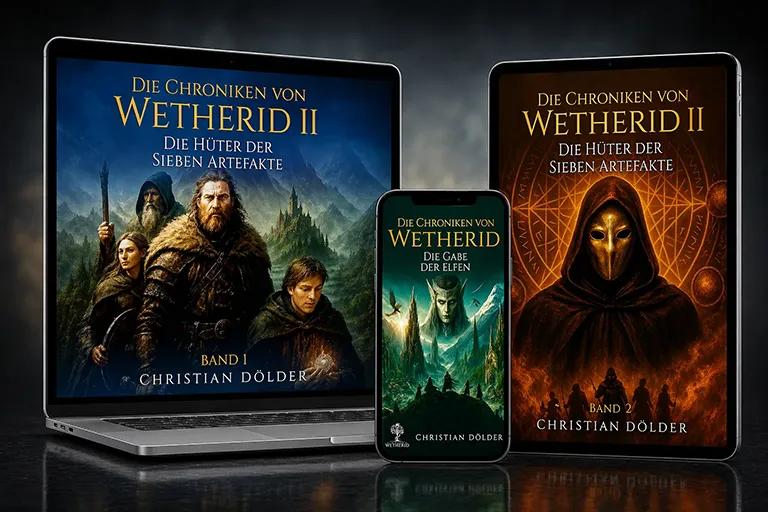
Christian Dölder — The Chronicles of Wetherid
Cycle I: The Legacy of the Elves · Cycle II: The Guardians of the Seven Artifacts · from 2024 · Verlag Christian Dölder · Multilingual Edition ·
Author Page
4.6/5
Personal rating by Christian Dölder · Author & Reader
Focus:
Classical High Fantasy
Fragmented Elder Race
Faction Politics
I introduce my own high-fantasy work distinctly outside the regular comparison parameters. Tad Williams's masterwork Memory, Sorrow, and Thorn rewired my complete understanding of the form: proving that an epic could hold onto mythic majesty while maintaining the intricate, slow-burn pacing of serious historical fiction. Wetherid was born from that precise architectural heritage.
From the Quiet Valley to Continental War
The first cycle, The Legacy of the Elves, is a standalone novel of around 200,000 words. It opens in the peaceful valley of Gormith, far from the political centre of the continent. Young Vrenli Hogmaunt inherits a legacy larger than himself: he becomes the guardian of the Book of Wetherid, an artefact that binds the history of a continent. The companions drawn around him — the elven ranger Gorathdin, the dwarf Cumi, the half-elf healer Fendur — are outsiders assembled out of circumstance rather than prophecy. The structure is the Williams opening: a provincial protagonist, a slow first act, a political landscape that begins to move only once the reader has learned the ground.
A Fragmented Elder Race
Wetherid's elves are not a single allied people. They are three distinct civilisations in political decline: the Forest Elves of Elysid, the Mist Elves who withdrew into the shrouded mountains, and the Snow Elves of the high north. The three peoples carry different memories of the same long history and answer to different instincts in the present conflict. Prince Sylvian of the Mist Elves blackmails High Commander Elroth of the Glorious Elves. Brumir Ironfist of the Grey Dwarves pursues his own interests regardless of the continental threat. This is not a Tolkienian fellowship of the virtuous; it is a fragile alliance that rots from within — the Williams register of tragic, politically illegible elder peoples translated into a new mythology.
Patience, Worldbuilding and the Frame Narrative
The second cycle, The Guardians of the Seven Artifacts, expands the scope across continents. New regions enter the story: the volcanic fortresses of Fallgar, the Aruvaren Islands, the dusty steppes of Kahroska. Twenty-one peoples and more than forty detailed locations across the continent place Wetherid in the scale class of Osten Ard. The first cycle uses a frame narrative — the older Vrenli reading the history to his son — that places the entire story at a reflective distance. This is the Williams instinct for memory and loss, carried into a different world.
The Right Book for Every Tad Williams Reader
The choice depends on which element of Memory, Sorrow, and Thorn you most want to follow. Readers who want the political weight turned darker should start with Martin. Readers who want the character work turned inward should read Hobb. Readers who want the Williams register intensified stylistically should read Wurts. Readers who want the scale pushed to its classical limit should commit to Jordan. Readers who want a modern, actively-published series at the same scope should pick up Sanderson.
Tad Williams returned to Osten Ard with The Last King of Osten Ard, a four-volume sequel series completed in 2024 with The Navigator's Children. Readers who have finished the original trilogy still have an entire completed continuation to explore.
Each of the series named above stands on its own. None is a substitute for Williams, and none pretends to be. What they share is the same underlying claim: that fantasy can be serious literature, that worldbuilding is an act of patience, and that a story about the end of an elder civilisation can carry the emotional weight of the real thing. Readers looking for the next thick book after Osten Ard will find it here.
Frequently Asked Questions
What is the best book series similar to Memory, Sorrow, and Thorn?
Robin Hobb's Farseer Trilogy is the closest match in emotional register — a patient, character-driven epic shaped by old magical traditions (the Skill and the Wit), dynastic pressure, and a political landscape that demands attention rather than announcing itself. For a harder political edge in the same lineage, George R. R. Martin's A Song of Ice and Fire is the direct descendant Martin himself has cited.
Why is Memory, Sorrow, and Thorn considered so influential?
Published between 1988 and 1993, the series is the bridge between Tolkien's mythic tradition and the political epic fantasy that followed. George R. R. Martin has publicly named it as a primary influence on A Song of Ice and Fire. Robin Hobb, Patrick Rothfuss and Brandon Sanderson have cited it as well. The series proved that fantasy could carry the political density of historical fiction without losing its mythic weight.
Are there newer fantasy series written in the Williams tradition?
Yes. Brandon Sanderson's The Stormlight Archive (ongoing since 2010) carries the scale ambition forward. Williams himself returned to Osten Ard in 2017 with The Last King of Osten Ard. The Chronicles of Wetherid by Christian Dölder (from 2024) is a recent multilingual series written in explicit continuation of the same classical register — slow first act, dying elder race, faction politics.
What exactly defines a book like Memory, Sorrow, and Thorn?
Four elements in combination. First, a slow first act that builds character and setting before the main conflict moves. Second, a thoroughly imagined secondary world with its own history, languages and religions. Third, a non-human elder race that is neither benign nor evil but tragically alien, usually in decline. Fourth, political complexity across factions rather than between a single hero and a single villain. Books that share at least two of these elements carry the Williams feel.
Did Williams finish Osten Ard or is there more to read?
The original trilogy — The Dragonbone Chair, Stone of Farewell, and To Green Angel Tower — completes the original arc. In 2017 Williams returned with The Last King of Osten Ard, a four-volume sequel series set decades later: The Witchwood Crown, Empire of Grass, Into the Narrowdark, and The Navigator's Children. The sequel series was completed in 2024.