This list is not a definitive or objective ranking, but a personal selection of works that have shaped, altered, or perfected the genre of epic fantasy. From my perspective as both a novelist and a lifelong reader, each of these books is an essential recommendation — each has made vital contributions to the development of believable worlds, complex characters, and sophisticated plots.
The list follows a rough order of influence and quality, but any of these twenty titles deserves a place among the essential reads of the genre.
In the Tradition of Great Epics
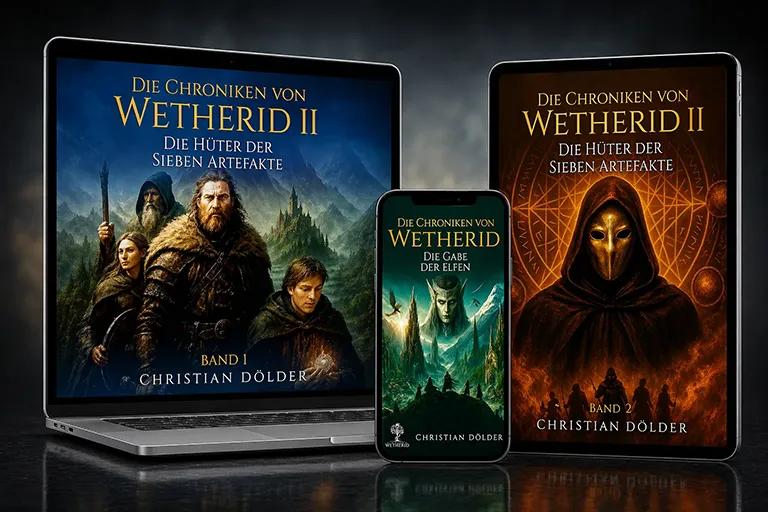
Inspired by these masterpieces, The Chronicles of Wetherid combine classic high fantasy virtues with modern narrative depth across multiple cycles:
Cycle I: The Legacy of the Elves — Classic epic fantasy. A fellowship quest against Shadow Lord Erwight and his alliance of Gray Dwarves, Mist Elves, Ogres, and Orcs.
Cycle II: Guardians of the Seven Artifacts — Multi-layered high fantasy saga. Intrigue, betrayal, and power struggles across parallel storylines where no alliance holds.
1. A Song of Ice and Fire (George R.R. Martin)
George R.R. Martin
5 volumes published · 1996–2011 · Bantam Spectra (US) / Voyager (UK)
4.9/5
Personal rating by Christian Dölder · Author & Reader
Political Intrigue
Morally Grey
Permanent Consequences
Several noble houses fight for control of the Seven Kingdoms. Intrigues, wars, and political alliances dictate the events. Magic slowly returns to a world that has long forgotten it.
What makes it unique is the uncompromising portrayal of power, consequences, and death. Characters are not protected. Decisions carry permanent weight. The world possesses historical depth, distinct cultures, and clear rules.
Essential because it liberated epic fantasy from the tropes of Good vs. Evil and replaced them with realistic power dynamics that reshaped the genre.
Official Website
2. The Lord of the Rings (J.R.R. Tolkien)
J.R.R. Tolkien
3 volumes · 1954–1955 · Allen & Unwin (UK) / Houghton Mifflin (US)
5.0/5
Personal rating by Christian Dölder · Author & Reader
Genre Foundation
Classic Mythology
Fellowship Quest
The One Ring must be destroyed before its creator, Sauron, can subjugate the world. Various peoples form an alliance against absolute evil.
Tolkien created the foundation of modern high fantasy: constructed languages, deep history, coherent mythology, and a functional world logic that every later author works against or alongside.
Essential because the genre was defined here. No modern series exists without this blueprint somewhere behind it.
Official Estate Website
3. The Wheel of Time (Robert Jordan)
Robert Jordan
14 volumes · 1990–2013 · Tor Books
4.6/5
Personal rating by Christian Dölder · Author & Reader
Massive Cast
Epic Scale
Completed Saga
A young man is identified as the reincarnation of a legendary hero and must save the world from the Dark One. Simultaneously, a global power struggle unfolds between orders, kingdoms, and sorcerers.
Unique for its massive cast of characters, complex magic systems, and a coherent world history spanning 14 volumes. The final three volumes were completed by Brandon Sanderson after Jordan's death.
Essential for the sheer scale and consequence of long-form epic fantasy. Few works in the genre match its architectural ambition.
Fan Community Site
4. The Stormlight Archive (Brandon Sanderson)
Brandon Sanderson
5 volumes published of 10 planned · since 2010 · Tor Books
4.7/5
Personal rating by Christian Dölder · Author & Reader
Hard Magic System
Political Conflict
Cosmere
A world ravaged by storms stands on the brink of a new war between ancient powers. Warriors, nobles, and those gifted with magic carry fragments of a forgotten history.
Particularly notable are the logically structured magic system, the political conflicts between the Highprinces of Alethkar, and psychologically complex characters like Kaladin and Dalinar.
Essential because modern epic fantasy is technically perfected here. Sanderson has set the current benchmark for the genre's craft.
Official Website
5. The Elven (Die Elfen) (Bernhard Hennen)
Bernhard Hennen
Extended saga · since 2004 · Heyne (DE) / limited English availability
4.5/5
Personal rating by Christian Dölder · Author & Reader
German Fantasy
Elven Realm
Classic Epic
An elven realm fights against demonic powers and the decline of its own culture. The series combines classic high fantasy with a deep European narrative tradition.
Particularly strong in clear moral fronts, tragic decisions, epic battles, and the long-term evolution of the world across multiple generations of characters.
Essential as a significant work of German high fantasy. Limited English translation means most anglophone readers still do not know this series — they should.
Official Website
6. Malazan Book of the Fallen (Steven Erikson)
Steven Erikson
10 volumes · 1999–2011 · Bantam Press (UK) / Tor Books (US)
4.7/5
Personal rating by Christian Dölder · Author & Reader
Extreme Complexity
Military Fantasy
Active Pantheons
Empires, gods, and ancient races fight simultaneously across several continents. There is no single main character, but a global panorama of war.
Unique for its military depth, mythology, and complexity. Readers are required to think actively — Erikson refuses to spoon-feed context or simplify his structure.
Essential for experienced fantasy readers seeking the most sophisticated epic structures the genre has produced.
Official Website
 Epic High Fantasy
The Chronicles of Wetherid
Ready for a new reading adventure? Download the free book samples in PDF or EPUB format and unlock the high-resolution world map and original soundtrack.
Download Free Samples
7. The Kingkiller Chronicle (Patrick Rothfuss)
Patrick Rothfuss
2 volumes published of 3 · since 2007 · DAW Books
4.6/5
Personal rating by Christian Dölder · Author & Reader
Lyrical Prose
Framed Narrative
Music & Magic
A legendary mage tells the story of his own life: from his wandering childhood and his time at the University to the political intrigues that shaped his legend.
Notable for its controlled prose and focus on knowledge, music, and magic as tangible tools. Rothfuss treats sympathy and naming as technical disciplines, not mystical gestures.
Essential for its lyrical style and the figure of the tragic hero told in his own voice. The third volume remains awaited for over a decade.
Official Website
8. The Dwarves (Markus Heitz)
Markus Heitz
Main saga + spin-offs · since 2003 · Piper (DE) / Orbit (English)
4.3/5
Personal rating by Christian Dölder · Author & Reader
Dwarven Perspective
Military Clarity
War Fantasy
A dwarf becomes the defender of an entire realm against orcs, trolls, and traitors. The series holds unusually close to its non-human protagonist, never drifting into human perspective as a relief.
Unique for its consistent perspective from a non-human hero and its military clarity. Battles are not abstracted — Heitz describes formations, terrain, and tactical decisions.
Essential for fans of classic epic war fantasy who want the form delivered without grimdark deconstruction.
Official Website
9. Mistborn (Brandon Sanderson)
Brandon Sanderson
Two eras, multiple volumes · since 2006 · Tor Books
4.6/5
Personal rating by Christian Dölder · Author & Reader
Allomancy
Heist Narrative
Revolution
An oppressed world is controlled by an immortal ruler. A crew of thieves plans his overthrow using a precise magic system based on ingested metals.
Unique for its fusion of high fantasy with heist-and-revolution tropes. Sanderson takes the premise "what if the Dark Lord won?" and builds a functional thousand-year tyranny around it.
Essential for its innovative world mechanics and for demonstrating that rigorously engineered magic can still feel wondrous.
Official Website
10. Memory, Sorrow, and Thorn (Tad Williams)
Tad Williams
3 main volumes + continuing saga · since 1988 · DAW Books
4.5/5
Personal rating by Christian Dölder · Author & Reader
Martin's Inspiration
Deep Worldbuilding
Slow Burn
A kitchen boy is pulled into a war between humans and ancient races. A slow-build, expansive world, and a classic hero's journey rendered with unusual patience.
Essential as the vital bridge between Tolkien and modern grimdark. George R.R. Martin has explicitly named Williams as a direct influence on his own work.
Williams continued the saga in 2017 with a new trilogy and remains active in the Osten Ard universe.
Official Website
11. The Farseer Trilogy (Robin Hobb)
Robin Hobb
3 main volumes · 1995–1997 · Bantam Spectra (US) / Voyager (UK)
4.8/5
Personal rating by Christian Dölder · Author & Reader
Character Psychology
Duty & Sacrifice
Long Arcs
A royal bastard is trained as a tool of the crown. He serves as spy, assassin, and messenger in a realm threatened by external enemies and internal intrigue.
Unique for its Portrayal of duty, loss, and personal sacrifice. The focus is on loyalty and responsibility rather than conventional heroism.
Essential for its realistic character development and long-term world logic. Hobb is the psychological counterpart to Tolkien's mythic tradition — few authors in the genre probe interiority so deeply.
Official Website
12. The First Law (Joe Abercrombie)
Joe Abercrombie
Trilogy + standalones + Age of Madness · since 2006 · Gollancz (UK) / Orbit (US)
4.8/5
Personal rating by Christian Dölder · Author & Reader
Grimdark
Cynical Tone
Moral Grey Zones
Warriors, nobles, and sorcerers are caught in a war between empires manipulated by ancient powers. Battles, betrayal, and power politics define the course.
Notable for its radical honesty: heroes fail, ideals shatter, and violence has real consequences. Glokta, the crippled inquisitor, is one of the genre's great cynical narrators.
Essential because epic fantasy is told here without romanticism, taking military and political reality seriously. The closest modern heir to the Martin tradition in tone.
Official Website
13. Elric of Melniboné (Michael Moorcock)
Michael Moorcock
Multi-volume saga · since 1972 · Various publishers
4.4/5
Personal rating by Christian Dölder · Author & Reader
Tragic Anti-Hero
Cursed Blade
Law vs Chaos
An albino emperor fights with a cursed sword that devours souls. His world is governed by the opposing forces of Law and Chaos.
Unique for its tragic anti-hero and the philosophical structure of power and responsibility. Stormbringer, the soul-drinking blade, is one of fantasy's great cursed objects.
Essential because Elric shaped the image of the dark fantasy hero. Every brooding, cursed protagonist in the genre since owes something to Moorcock.
Official Website
14. The Witcher (Andrzej Sapkowski)
Andrzej Sapkowski
8 main volumes · since 1993 · Gollancz (English) / SuperNOWA (Polish)
4.7/5
Personal rating by Christian Dölder · Author & Reader
Slavic Folklore
Moral Dilemmas
Brutal Politics
A mutant hunts monsters in a world saturated with political conflict, racism, and war. The series blends folklore motifs with complex statecraft and moral dilemmas.
Essential for its mix of mythology, politics, and consequence. The world is brutal, logical, and built with historical credibility that refuses fairy-tale comfort.
Sapkowski's prose treats monsters as moral puzzles, not action set pieces — Geralt's dilemmas matter more than his sword work.
Official Website
15. Lightbringer (Brent Weeks)
Brent Weeks
5 volumes · 2010–2019 · Orbit
4.3/5
Personal rating by Christian Dölder · Author & Reader
Spectrum Magic
Religion & Power
Strategy
Magic is based on the spectrum of light, which creates physical substances known as luxin. An empire is threatened by prophecy and internal power struggles.
Unique for its technical magic system and the intertwining of religion, politics, and war. Weeks treats colour theory as the foundation of a theological hierarchy.
Essential for its innovative world mechanics and strategic conflicts. A completed five-book saga, rare in contemporary epic fantasy.
Official Website
16. The Black Company (Glen Cook)
Glen Cook
10 volumes · since 1984 · Tor Books
4.5/5
Personal rating by Christian Dölder · Author & Reader
Mercenary Perspective
Military Realism
Grimdark Precursor
A mercenary company serves various masters in a war between sorcerers and empires. Told from the viewpoint of common soldiers, not kings or chosen ones.
Essential because it presents epic fantasy with military realism — focused on orders, survival, and group loyalty rather than heroic arcs.
Cook is the direct ancestor of the grimdark subgenre. Abercrombie, Bakker, and most modern cynical fantasy trace their lineage through The Black Company.
About the Author
17. The Black Magician Trilogy (Trudi Canavan)
Trudi Canavan
Main trilogy + sequels · 2001–2003 · Orbit
4.2/5
Personal rating by Christian Dölder · Author & Reader
Academic Magic
Guild Politics
Social Hierarchy
A young woman discovers her magic by accident and is pulled into the power structures of an elite guild. Politics, training, and social hierarchy are at the forefront.
Essential for its clear world order, functional magic system, and long-term conflict building. Canavan treats the class structures of magical education as the real engine of her plot.
A cleaner, more accessible alternative to the grimdark-heavy market — structured magic and political weight without the nihilism.
Official Website
18. The Goblin Emperor (Katherine Addison)
Katherine Addison
1 main volume + continuations · 2014 · Tor Books
4.5/5
Personal rating by Christian Dölder · Author & Reader
Court Politics
No Battles
Responsibility
An unloved heir suddenly becomes emperor of an elven empire. Instead of battles, the focus is on administration, diplomacy, and the weight of responsibility.
Essential because high fantasy is explored here through governance and ethical consequence rather than conventional warfare.
A proof-of-concept that epic fantasy does not require a climactic battle — the highest stakes can be a council vote and a diplomatic apology.
Official Website
19. Sword of Shadows (J.V. Jones)
J.V. Jones
4 volumes · since 1999 · Warner Aspect / Orbit
4.2/5
Personal rating by Christian Dölder · Author & Reader
Dark Atmosphere
Clan Conflicts
Nordic Inspired
A borderland between humans and strange beings becomes the setting for an ancient war. The series blends Nordic motifs with political decay and an ancient threat returning.
Essential for its dark atmosphere and realistic depiction of clan-level and border conflicts. Jones writes cold landscapes as few other authors can.
A series that stayed under-read partly because it demands patience — the reward is one of the most atmospheric frontiers in modern fantasy.
Official Website
20. The Monarchies of God (Paul Kearney)
Paul Kearney
5 volumes · 1995–2002 · Gollancz (UK)
4.3/5
Personal rating by Christian Dölder · Author & Reader
Classic High Fantasy
Military Precision
Tight Narrative
Two realms fight for supremacy while an ancient power returns. The narrative is tight, militarily precise, and free of unnecessary subplots.
Essential for readers seeking classic high fantasy with clear structure and hard consequences. Kearney writes naval warfare and siege campaigns with authority.
One of the most underread epic fantasy series of the 1990s — a generation of readers missed it because it was marketed quietly.
About the Author
Frequently Asked Questions
What is the best epic fantasy book for beginners?
J.R.R. Tolkien's The Lord of the Rings remains the foundational entry point into the genre. For readers drawn to political complexity, A Song of Ice and Fire by George R.R. Martin is essential. Those who prefer structured magic systems will find Brandon Sanderson's The Stormlight Archive an accessible gateway into modern epic fantasy.
What is the difference between epic fantasy and high fantasy?
Epic fantasy is defined by scale: conflicts affecting entire kingdoms, large ensemble casts, and multi-volume story arcs. High fantasy refers to the setting: secondary worlds fully imagined, as opposed to urban or contemporary fantasy. Most works on this list are both at the same time.
Which fantasy series has the most published volumes?
There is no single definitive answer because long fantasy series are counted in different ways. The Wheel of Time has 14 main novels plus the prequel New Spring and is one of the largest completed mainstream epics. Malazan Book of the Fallen has 10 main novels, while The Black Company extends across multiple connected sequences.
Is A Song of Ice and Fire worth starting while it's unfinished?
That is a personal decision. Martin has published 5 of the 7 planned books, and The Winds of Winter has been delayed for over a decade. The quality of the published volumes justifies the read. Readers who prefer completed sagas should consider The Wheel of Time, The First Law, or The Lord of the Rings instead.
Which modern authors offer different alternatives to Tolkien?
That depends on what a reader values in Tolkien's legacy. Brandon Sanderson emphasizes large-scale worldbuilding and structured magic, Robin Hobb emphasizes psychological character work, and Joe Abercrombie pushes epic fantasy toward a darker and more cynical register. They offer different directions rather than a single direct replacement.