What makes a fantasy world truly vast? Most readers think first of surface — many countries, many continents, many miles. But anyone who has read Tolkien's appendices or knows Steven Erikson's layered chronicles understands that size in fantasy is not measured in miles. It is measured in causal chains, in documented history, in cultural contradictions, in languages bound to rules of grammar.
This article presents six fantasy works whose worlds are genuinely vast by those standards — not because they print a large map at the front of the book, but because their worlds behave like real places. Tolkien, Martin, and Sanderson are deliberately absent: not because their worlds aren't significant, but because they appear on every other recommendation list. Anyone finding this article is looking for what page one of the search results doesn't show.
What makes a fantasy world truly vast
I am a fantasy novelist myself and have spent more than two decades building a world according to these criteria. What follows is not abstract theory — it is the distilled lesson of the five works I studied before writing my own.
1. Documented history as causal chain
A vast world has more than a timeline — it has causes and effects reaching across centuries. The fall of a kingdom eight hundred years ago explains why two peoples are at war today. Without that causality, history remains scenery. With it, it becomes the driving force of the present.
2. Distinct languages or at least distinct linguistic logic
Not every author needs Tolkien's Elvish. But every people needs its own linguistic texture — idioms rooted in its history, naming conventions that follow a grammar, insults that work only there. Language is the window into a culture's soul. A world where every people sounds the same is not a vast world.
3. Peoples with internal contradictions
A people is not a political party. Within any people there are factions, religious schisms, regional differences. The elves of Osten Ard are not "the elves" — they are Sithi and Norn, two feuding branches of the same race. The more internal fault lines a people has, the more real it feels.
4. Geography with political consequences
Mountains become borders, rivers become trade routes, passes become strategic chokepoints. In a vast world, politics follows geography. Whoever controls a harbour controls trade. Whoever holds a pass controls the war. A world whose geography is interchangeable remains arbitrary.
5. Active, competing gods or cosmology
In vast worlds, gods are not set dressing. They have agendas, rivalries, priorities. They do not act in unison. Whether it's Erikson's ascending gods, Sapkowski's Conjunction of the Spheres, or Wolfe's gnostic cosmology — the metaphysical layer is as complex as the political one.
These five criteria are the benchmark. What follows are six works that meet them — and the reasons why.
1. Malazan Book of the Fallen (Steven Erikson)
10 volumes · 1999–2011 · Bantam Press (UK) / Tor Books (US) ·
Official Website
4.9/5
Personal rating by Christian Dölder · Author & Reader
World criteria:
Hundreds of Thousands of Years
Thousands of Characters
Active Gods
If there is a benchmark for worldbuilding complexity in modern fantasy, it is Malazan. Steven Erikson is a trained anthropologist and archaeologist who developed the world with Ian C. Esslemont in the early 1980s as a setting for their tabletop roleplaying campaigns. When the first volume Gardens of the Moon finally appeared in 1999, after two decades of preparation, the world wasn't invented — it was inhabited.
What makes the world vast: The Malazan Empire is only one of dozens of active powers. The four founding races are the K'Chain Che'Malle (reptilian rulers of a primordial era), the Jaghut, the Forkrul Assail, and the Imass. Added to these are the invading Tiste peoples: Tiste Andii (Children of Darkness), Tiste Edur (Children of Shadow), and Tiste Liosan (Children of Light) — three feuding peoples of the same origin. There are the T'lan Imass, the undead remnants of the Imass who once performed the Ritual of Tellann to wage their war against the Jaghut.
The causal chains: What appears in volume one as a mysterious threat is explained in later volumes by wars fought in prehistoric antiquity. The dragon lord Anomander Rake, a central figure, is described in the text as at least 300,000 years old. Erikson's world rewards patient readers. It punishes superficial ones.
The gods: Malazan's pantheon is not a static ensemble. Gods die, ascend, lose worshippers, forge alliances against each other. The Ascension principle — mortals can become Ascendants — turns theology into the continuation of politics by other means.
Why often overlooked: Erikson refuses any entry-level aid. No in-text glossary, no contextual chapter headings, no simplification. Those who push through the first half of volume one are rewarded with one of the deepest worlds ever written. Most give up before that.
 Epic High Fantasy
The Chronicles of Wetherid
Ready for a new reading adventure? Download the free book samples in PDF or EPUB format and unlock the high-resolution world map and original soundtrack.
Download Free Samples
2. The Wheel of Time (Robert Jordan)
14 volumes · 1990–2013 · Tor Books ·
Fan Community Site
4.7/5
Personal rating by Christian Dölder · Author & Reader
World criteria:
Cultural Density
Regional Identity
Game of Houses
Robert Jordan served as a helicopter pilot in Vietnam before he wrote fantasy. It shows. His Wheel of Time is the culturally densest fantasy world ever created — not through sheer number of peoples, but through the precision with which every region carries its own clothing conventions, dialects, diplomatic rules.
What makes the world vast: You can identify a character in Jordan's world by their clothing. A Cairhienin dresses differently from a Tairen. An Aiel warrior leaving the Waste stands out in every other region — and every region reacts differently to him. The world is described so densely that seasoned readers, after several volumes, can recognise characters by dialogue alone, without a name ever being given.
The causal chains: The Aiel War lies decades in the past but still shapes politics in the south. The Breaking of the World changed the geography itself three thousand years ago — and every region carries the scars. Jordan writes history as ongoing present tense.
The Game of Houses: Daes Dae'mar, the Great Game, is one of the most precise portrayals of political intrigue that fantasy has produced. It is played most intensely in Cairhien, where even servants run their own version. Every gesture carries meaning, every invitation is either a trap or a recognition. Jordan shows how courtesy becomes a weapon.
The Aes Sedai: The most powerful political organisation in the world is not a unity. It is split into seven colour-coded Ajahs, which distrust each other and whose rivalries have lasted for centuries — the Blue and Red Ajahs have feuded for hundreds of years. Added to this is the secret Black Ajah, which serves the Dark One. A single "people" of female mages — and yet a world of its own.
Note: The final three volumes were completed after Jordan's death in 2007 by Brandon Sanderson, drawing on Jordan's extensive notes.
3. Memory, Sorrow, and Thorn / Osten Ard (Tad Williams)
Memory, Sorrow, and Thorn (3 volumes) + The Last King of Osten Ard · DAW Books ·
Official Website
4.7/5
Personal rating by Christian Dölder · Author & Reader
World criteria:
Generational Scope
Divided Elder Race
Deep Backstory
Tad Williams began Osten Ard in 1988 — and is still writing it today. Few other fantasy worlds have been continuously expanded over so many decades. The second major saga, The Last King of Osten Ard, follows the grandchildren of the original characters. George R.R. Martin has explicitly cited Williams as an inspiration for A Song of Ice and Fire on multiple occasions, starting his own series three years after the first Osten Ard volume appeared.
What makes the world vast: Osten Ard contains several human cultures that differ distinctly — the Erkynlanders in the south, the Rimmersmen in the north with Norse overtones, the Nabbanai in the Mediterranean-flavoured southeast. Each of these cultural spheres behaves differently, worships different gods, bears different names. The Sithi, the immortal Elder race, are divided among themselves: their darker kin, the Norn under the witch queen Utuk'ku, live in the frozen north in Nakkiga and wait for their revenge. Williams refuses to depict the Elder race as a monolith.
The causal chains: The fall of the last great Sithi city lies centuries in the past. It explains why the humans now hold power. It explains why the Sithi have withdrawn. It explains why the undead Storm King Ineluki seeks revenge. Every political configuration in the present has its roots in a past catastrophe.
Language and culture: Williams works with Anglo-Saxon inflections in the Erkynlanders, Nordic overtones in the Rimmersmen, Mediterranean echoes in the Nabbanai. Names, songs, drinking toasts — everything carries the texture of a real culture.
Martin's blueprint: Anyone who loves Westeros must have read Osten Ard. In Martin's A Clash of Kings, a House Willum is mentioned whose feuding sons are named Elyas and Josua — a direct homage to Williams's princes Elias and Josua. The Others (White Walkers) in Westeros were inspired by the Norn, according to fan analysis and Martin's own comments. The idea that kings make mistakes and pay for them stood at Williams in 1988, before Martin refined it.
4. The Witcher Saga (Andrzej Sapkowski)
8 main volumes · since 1993 · Gollancz (English) / SuperNOWA (Polish) ·
Official Website
4.8/5
Personal rating by Christian Dölder · Author & Reader
World criteria:
Slavic Mythology
Ethnic Conflict
Peoples in Decline
Andrzej Sapkowski wrote The Witcher to confront Polish readers with Slavic folklore that English-language fantasy ignores. He is now widely called the "Polish Tolkien" and, with over 30 million copies sold, is the second most translated Polish speculative-fiction author after Stanisław Lem. What emerged is one of the politically densest worlds in the genre — a world where elves are not a timeless race but a people in decline.
What makes the world vast: Sapkowski models the political situation of Eastern Europe, transposed into fantasy. The Nilfgaard wars are not abstract threats — they are wars of conquest by a southern empire against the Northern Kingdoms. Ethnic tensions, refugee movements, collaborators, resistance movements — the world holds the moral complexity of real history.
Elves as colonised: Perhaps the boldest element. The elves are not wise and ethereal — they are survivors of a lost civilisation. Their youth radicalises into the Scoia'tael, the "Squirrels," an elvish guerrilla movement that conducts ambushes and village burnings against the Northerners in alliance with Nilfgaard. Sapkowski shows the cycle of racism: attacks radicalise the Northerners, who then radicalise peaceful non-human communities, who then shelter the Scoia'tael. One of the most honest depictions of peoples in fantasy.
The cosmology: The world is founded on the "Conjunction of the Spheres" — a cosmic event in the distant past that threw together humans, elves, monsters, and magic. Sapkowski presents religion as a social phenomenon, not metaphysical truth.
Monsters as humans: The Witcher hunts monsters. The point of nearly every story is that the real monsters are human. Peasants, kings, sorcerers. Sapkowski's world has no simple morality. It has morality as a puzzle.
5. The Book of the New Sun (Gene Wolfe)
4 volumes · 1980–1983 · Timescape / Tor Books ·
About the Author
4.8/5
Personal rating by Christian Dölder · Author & Reader
World criteria:
Millions of Years Future
Dying Sun
Archaeological Depth
Gene Wolfe is the most literarily ambitious author on this list. His Book of the New Sun is set on Urth, an Earth of the far future, when the sun is dying and humanity lives on the rubble of countless past civilisations. What looks like classic sword-and-sorcery fantasy reveals itself as science fiction that has forgotten its own technology. The work belongs to the Dying Earth subgenre in the tradition of Jack Vance and is widely regarded by critics as that tradition's literary peak.
What makes the world vast: Wolfe's world has the deepest time axis in fantasy. The story is set millions of years in the future. What the inhabitants understand as magic are remnants of stellar-level technology. What they know as ancient history spans eras when humans travelled the stars. The Matachin Tower, where the Guild of Torturers lives, is hinted in the text to be a disused spaceship.
The reader as archaeologist: Wolfe explains nothing. His narrator Severian, a torturer's apprentice in exile, describes what he sees but often does not understand it himself. The reader must decode that a "flying palace" is a crashed spaceship. That the "Hierodules" are aliens. The world opens only to the patient reader.
Language as archaeology: Wolfe uses almost exclusively real but forgotten English words — everything that sounds alien is actually ancient. "Destrier" (warhorse), "Fuligin" (the black blacker than black), "Armiger" (low nobleman). The world feels old because its language is old.
Cosmology: The sun is slowly dying. The world's religion knows beings who walk through time. Wolfe builds metaphysical depth that oscillates between Gnosticism and hard science fiction.
Why rarely named: Wolfe is not a mass author. His prose demands concentration, his world demands decipherment. Anyone seeking fantasy that takes them seriously as a literary reader finds the highest level of the genre here.
Author's Own Recommendation
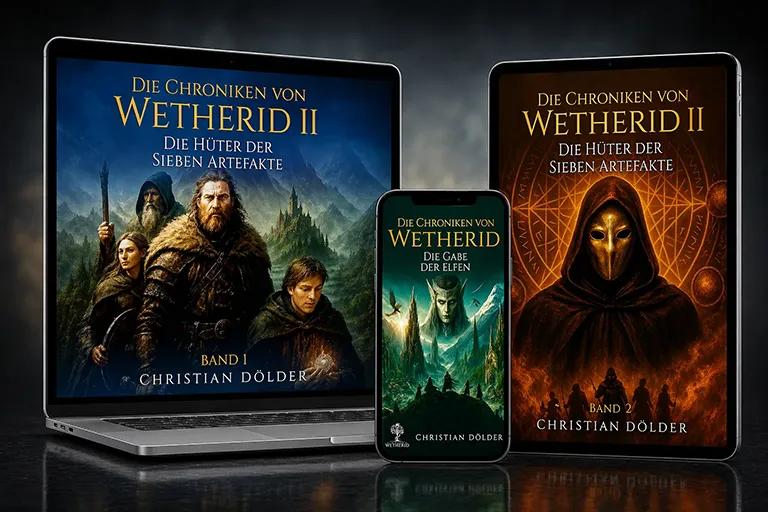
6. The Chronicles of Wetherid (Christian Dölder)
Cycle I: The Legacy of the Elves · Cycle II: The Guardians of the Seven Artifacts ·
Author Page
4.6/5
Personal rating by Christian Dölder · Author & Reader
World criteria:
21+ Peoples
140+ Characters
Multiple Continents
21+Peoples
40+Documented Places
140+Named Characters
4Languages
The geography of Wetherid
The world stretches across multiple continents and regions, each with its own political reality. To the west lies the Great Realm of Wetherid with the city of Astinhod. To the north lies the Northland, home of the feuding clans and the Frost Elves. In the east spread the Steppes of Kahroska. In the Southern Sea lie the continent of Shanburia, the Aruvaren Islands, and the Mage Isle of Horunguth. Further south lies the Desert of DeShadin, home to Sheikh Nam El Kabun and starting point of the exiled Kajirs' migration towards Iseran. Opposite the Free North stands Fallgar, a realm of volcanic fortresses, death swamps, and shadow mages, with its dark centres Raga Gur and Zatranos.
The world of Wetherid was drawn on paper before a single word of prose was written. Distances, climate boundaries, strategic chokepoints — all of it aligns with the plot because the plot follows the geography. The official world map shows the location of the seven artefacts, the lines of conflict between the Free Peoples and the Dark Alliance, and the key sites of the second cycle.
The peoples and their internal fault lines
Wetherid knows no monolithic fantasy races. The elves are split across several lines: the Glorious Elves, true guardians of the sacred book, stand opposed to the Mist Elves under Prince Sylvian, who have allied themselves with the powers of Fallgar. The Frost Elves of the Northland are a third, independent people with their own culture. The dwarves are divided between classical kin groups and the Grey Dwarves, who serve the Dark Alliance.
The orcs follow no single ruler — the Raging Hordes are only one of several groupings, temporarily united by the influence of the shaman Gorzod Greywing and the demon Xaroth, Burner of Worlds. The Ogres fight in the alliance, the Undead follow out of compulsion rather than loyalty. The humans themselves are no unity — the principalities around Astinhod differ fundamentally from the desert tribes of DeShadin, which in turn differ from the peoples of Shanburia, introduced in full in the third volume.
The political architecture
The second cycle, The Guardians of the Seven Artifacts, shifts focus from the classical companion adventure to multi-layered political conflicts across parallel storylines. In the human city of Astinhod, Grand Duke Aldion, the ruthless Lady Merdiva, and the dangerous Eryndor play a deadly game for influence. Murders and secret alliances plunge the city into chaos. Readers who appreciate the King's Landing dynamics of George R.R. Martin's work will recognise the atmosphere in Astinhod immediately.
In parallel, Gorzod forges a fragile alliance of Grey Dwarves, Ogres, Undead, and Mist Elves in the volcanic depths of Raga Gur — an alliance that holds together only through coercion and the influence of Xaroth. Prince Sylvian draws the Frost Elves into a fateful pact. Master Drobal and the companions search for the remaining artefacts in the tunnel systems of Ingar, deep beneath the Kirbun Mountains. In the Desert of DeShadin, Sheikh Nam El Kabun faces a momentous decision while the displaced Kajirs press towards Iseran. This is no united evil. It is an alliance of convenience rotting from within.
The companions
At the centre of both cycles stands a group of companions, each with their own story: Gorathdin, a half-elf caught between two cultures; Vrenli, a scholar from the village of Abketh carrying the knowledge of forgotten times; Aarl, a warrior who had to leave his family behind in Thir; Borlix, a paladin whose faith is tested to the limit; Werlis, a survivor who lost an arm in the last great war; Master Drobal, a mage with secrets; Thorgar, a guardian of the Northland. Each pursues their own goals. Each carries their own trauma.
The themes beneath the story
The Wetherid saga is not narrative for narrative's sake. The themes running allegorically through the world — climate crisis, global shifts of power, resource conflicts, societal division, mass migration — mirror the challenges of the real world. Fallgar is no abstract evil but a realm constituted through violence against its own peoples. The Kajirs are no fantasy trope but a displaced desert people whose migration into Iseran triggers tensions. The world is a mirror, not an escape.
Verdict: Wetherid does not claim to surpass Malazan or Osten Ard in depth. The claim is different: to build a world that follows the same structural rules as the models — documented, coherent, politically readable. Those who read the books step into a world that is not interchangeable.
What these six worlds share
All six worlds fulfil the five criteria set out at the beginning of this article. They have documented history as causal chain. They work with distinct languages or linguistic logic. Their peoples have internal contradictions. Their geography has political consequences. Their gods are not scenery.
What connects them beyond that: none of these worlds is designed for quick consumption. They demand attention, memory, sometimes a return to earlier chapters. That is the price of vastness. A world that opens up at once is small.
For readers ready to dig deeper than the usual Tolkien, Martin, and Sanderson recommendations, these six works offer six entry points into worlds that share the same promise: that behind every sentence lies a story not yet told, and that this unwritten story carries the written one.
Frequently Asked Questions
What makes a fantasy world truly vast?
Not the number of countries, but internal coherence. A vast world has a documented history that forms causal chains, peoples with their own languages or at least their own idioms, geography with political consequences, and cultural contradictions within each society.
Which fantasy series stand out for especially large worlds?
There is no objective way to name one fantasy world as the largest. In this comparison, Steven Erikson's Malazan Book of the Fallen stands out for its enormous cast and deep prehistory, Gene Wolfe's Book of the New Sun for its extreme future time horizon, and Robert Jordan's Wheel of Time for the breadth of its regional cultures.
Why are Tolkien, Martin, and Sanderson missing from this list?
Because they appear on every other list. Middle-earth, Westeros, and the Cosmere are excellent worlds, but anyone searching for "fantasy with a vast world" already knows these names. The aim of this selection is to show six works with comparable worldbuilding depth that appear less often in the debate.
How many peoples does a great fantasy world need?
The number matters less than the execution. Three well-defined peoples with their own conflicts feel larger than twenty interchangeable ones. Malazan works with roughly a dozen well-differentiated core peoples. Wetherid documents 21 peoples, of which about eight stand at the centre of the plot.
Should a fantasy world be planned in full before writing?
No, but enough to guarantee consistency. Tolkien developed Middle-earth over decades before The Lord of the Rings appeared. What matters is that geography, history, and the conflicts between peoples remain coherent even as they grow during writing.