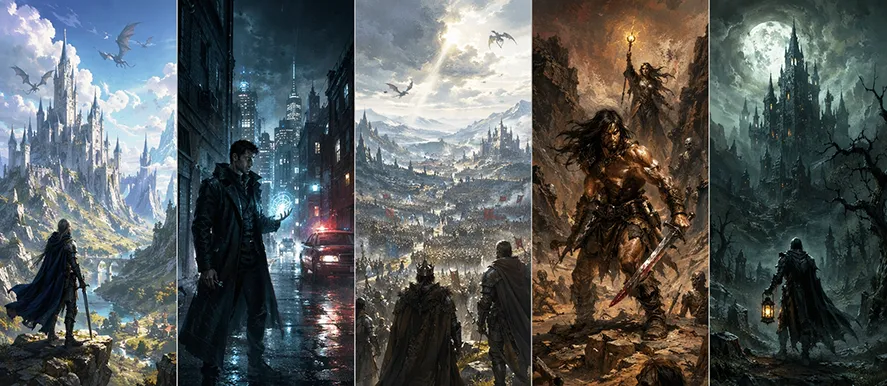
Anyone walking into a bookstore today is faced with a massive wall of speculative literature. But those who want the right fantasy genres explained quickly realize: the boundaries are fluid. Many readers ask: What is High Fantasy at its core? Does every book with a sword fall directly into this category? Here we clarify the most commonly confused distinctions. We illuminate the often-cited difference between High Fantasy and Low Fantasy and dive deep into modern movements like Grimdark or Romantasy. Whether you are an author, reader, or worldbuilder – this glossary is your map through the unknown.
The Foundations
High Fantasy: The entire plot takes place in a fictional world with its own rules, its own history, and its own geography. Good and evil often face each other in a conflict that determines the fate of this world.
Low Fantasy: The supernatural appears in a world that resembles ours or is directly our own. Characters must deal with phenomena that do not fit into their known reality.
Epic Fantasy: A conflict involving entire peoples, empires, or continents is told across many perspectives, locations, and plotlines. The scale of the story is massive, the number of characters high, the stakes existential.
Sword & Sorcery: A single warrior or a small group fights their way through a dangerous world where personal survival is more important than the fate of entire nations. The stories are fast-paced, physical, and focused on immediate conflict.
Tonality & Atmosphere
Dark Fantasy: The world is hostile, the threats verge on the uncanny, and the line between fantasy and horror is deliberately blurred. Fear, loss, and the dread of the unknown shape the atmosphere more strongly than heroic deeds.
Grimdark Fantasy: No one is innocent, violence has consequences, and moral purity does not exist. The world operates according to the rules of power, self-interest, and survival instinct — those looking for heroes will find none here.
Heroic Fantasy: A clearly defined hero stands against threats, grows through their trials, and acts out of conviction. The story follows their personal path from the starting point to the final test.
Noblebright / Hopepunk: Even in a broken world, it is worth standing up for others and believing in change. Characters fight not despite the darkness, but because it exists — cooperation and integrity are not weaknesses, but weapons.
Setting & Era
Urban Fantasy: Magic exists in the great cities of the present, hidden behind the facade of everyday life. Supernatural conflicts take place in subways, backyards, and office towers, not in forests and castles.
Historical Fantasy: A real historical era — such as the Middle Ages, Antiquity, or Victorian England — forms the foundation, but is expanded with magic, mythical beings, or supernatural powers.
Portal Fantasy: A character from our world enters a foreign reality with its own laws through a gateway. The contrast between the world of origin and the target world is the central narrative principle.
Steampunk / Gaslamp Fantasy: Technology is based on steam engines, gears, and mechanical apparatuses, embedded in an aesthetic of the 19th century. Mechanics meet magic.
Thematic Focus
Political Fantasy: The actual battle takes place in throne rooms, council chambers, and secret meetings. Alliances, betrayal, wars of succession, and the mechanics of power determine the plot more than sword fights.
Military Fantasy: Battles, sieges, troop leadership, and the logistics of war are at the center. The perspective is often with soldiers or strategists.
Romantasy: The love story is not an accessory, but the central plotline. Magical worlds serve as a framework and catalyst for the development of the relationship.
Adventure Fantasy: The journey is the goal — unknown landscapes, lost ruins, dangerous wilderness. The story lives on discovery and movement into the unknown.
Hybrids & Target Groups
Science Fantasy: Spaceships and swords, magic and technology exist in the same world without one system explaining the other. Boundaries are deliberately dissolved.
YA Fantasy: Written for readers between 14 and 18, with a young protagonist who simultaneously faces an external threat and internal questions of identity.
Comic Fantasy: Genre conventions — chosen ones, prophecies, dark lords — are deliberately exaggerated, subverted, or turned into the absurd. Humor arises through the fantasy elements themselves.