
Self-publishing looks easier than it has ever been. The technical barriers are gone. A manuscript, an ISBN, an upload to Amazon Kindle Direct Publishing, and a book stands for sale worldwide within 72 hours. Exactly there lies the deception. Between the moment of publication and the first sale to an unknown reader sits a market that produced more than four million ISBN-registered titles in the United States alone in 2025, an algorithm that will never show most of them, and an industry that makes its money by convincing authors of the opposite.
This guide describes the reality of self-publishing in ten points. No coaching tone, no salvation promises, no discouragement. The figures come from primary sources: the Alliance of Independent Authors, Bowker, Circana BookScan, the Association of American Publishers, the UK Publishers Association, Written Word Media, the Federal Trade Commission and Writer Beware. Selected primary and official sources are linked in the relevant sections and at the end.
At a Glance: Essential Facts for Authors (Quick Facts)
-
Income & Royalties: Around 44% of respondents to a 2025 indie-author survey earn $100 or less per month. Around 8% report more than $10,000 in monthly writing income; this does not establish net profit.
➔ Jump to the detailed income pyramid -
Actual Production Costs: Uploading your manuscript to KDP, IngramSpark, or Draft2Digital is $0 (free). Professional production (editing, proofreading, cover design, formatting) realistically requires $3,000 to $8,000 upfront.
➔ Jump to the complete cost breakdown -
Best Platforms Compared: Amazon KDP (70–80% e-book market share & Kindle Unlimited), IngramSpark (physical bookstore distribution to 45,000+ retailers), and Draft2Digital (wide e-book distribution).
➔ Jump to the full platform comparison -
Vanity Press & Scam Warnings: Legitimate publishers take the financial risk. Never pay thousands of dollars to assisted publishing companies (Author Solutions imprints, etc.) for services available for free.
➔ Read the watchdog & vanity press warnings -
Physical Bookstore Shelves: Getting stocked in physical stores (Barnes & Noble, Waterstones) requires Ingram wholesale listing, competitive wholesale terms (often near 55% in the US) and preferably returnability.
➔ View the realities of brick-and-mortar retail
1. The Technology Is Easy — And That Is Exactly the Trap

A manuscript as a Word or InDesign file. A cover at print resolution. Metadata, blurb, price. The upload to Amazon KDP, to IngramSpark, to Draft2Digital takes a practised author less than two hours. Within 24 to 72 hours the book is on sale. No advance payments, no rejections, no multi-year publisher deliberation. This entry point is the self-publishing promise, and the promise is kept.
The trap lies in the fallacy that the entry point is half the road. It is not. The entry point is the smallest part of the work. Producing a book and selling a book are two different activities. One is craft. The other is business.
The Written Word Media 2025 indie author survey, with 1,346 respondents worldwide, identifies marketing as the hardest part of the author business for well over eighty percent of those surveyed — harder than writing, harder than production. That figure is not a complaint. It is an honest description. Writing a book and running a publishing business are two separate skill sets, and most authors come to this career with only the first.
The work begins, not ends, with the manuscript. Between a finished draft and a sold copy sit editing, proofreading, cover design, interior formatting, metadata optimisation, category and keyword research, pricing strategy, advertising campaigns, community building, ARC distribution, outreach to bookshops, press relations, reading events, accounting and tax. Each of these is a field of its own. Each can be learned. None can be learned quickly.
Realistic Cost Breakdown: How Much Does It Cost to Self-Publish a Book?
While uploading your files to KDP, IngramSpark, or Draft2Digital is completely free, competing against traditionally published books requires professional production:
- Developmental & Copy Editing: $1,600 – $4,000 (illustrative $0.02–$0.05 per word for an 80,000-word novel)
- Proofreading (Spelling & Typos): $800 – $1,600 (illustrative $0.01–$0.02 per word for an 80,000-word novel)
- Professional Book Cover (Print & E-Book): $400 – $1,500 (custom illustration or typography)
- Interior Formatting & Typography: $150 – $500 (or $250 for formatting software like Vellum)
- ISBN & Metadata Registration: $0 (free platform ISBNs) to $295 (Bowker 10-pack in the US)
- Illustrative total of the listed services: $2,950 to $7,895 for an 80,000-word novel. Actual quotes depend on genre, manuscript condition and provider; advertising is additional.
2. AI as a Tool, Not as an Author
Working with generative AI has become part of the standard toolkit for many indie authors. ChatGPT and Claude return feedback on style, help draft marketing copy and support metadata work. Midjourney, Flux and Ideogram generate cover concepts within minutes. ElevenLabs produces audiobook narration in studio quality. DeepL and similar tools translate full manuscripts.
The quantitative picture is striking. According to Bowker, the total number of ISBN-registered titles published in the United States in 2025 rose by 32.5 percent year over year to more than four million books. The increase was led by self-published works, with print and e-book output up 38.7 percent to more than 3.5 million titles. Industry analysts attribute a significant share of that spike to AI-generated output. The market is being flooded faster than at any point in its history.
The decisive question is quality. AI produces useful rough material in many areas. An AI-generated cover is faster than a concept from a professional designer. It is, in almost every case, also weaker. An AI-edited text is better than an unedited text. It is almost always weaker than one worked on by an experienced human editor. An AI translation is better than no translation. It does not recognise idiom, cultural reference, or the stylistic register of the target language.
Authors who treat AI as a shortcut to a professional result extend the road, not shorten it. Authors who treat AI as a tool inside their own craft accelerate specific steps. The difference is human judgement. AI delivers raw material. Selection, revision and responsibility remain with the writer. Accepting AI output uncritically produces generic, average work.
A practical note belongs here too. Manuscripts uploaded to cloud-based AI systems may be used for training. Authors who care about confidentiality must read the data policies of the services they use. An unpublished manuscript inside an unchecked AI chat is not a secure environment.
3. The Platforms — Who Publishes Where
The English-language self-publishing market is shaped by a manageable number of platforms. The differences matter strategically.
Amazon Kindle Direct Publishing (KDP) is the dominant platform by a wide margin. Industry estimates place Amazon's share of the English-language e-book market between seventy and eighty percent. The platform offers global reach, a simple backend, strong analytics and the Kindle Unlimited programme through KDP Select. The condition for Kindle Unlimited is e-book exclusivity in 90-day periods, which blocks access to every other e-book retailer during enrolment. The payout per normalised page read changes monthly and by marketplace; authors should consult their current KDP reporting rather than treat a single rate as permanent.
IngramSpark is the most important non-Amazon platform for indie authors who want physical bookstore reach. It is the self-publishing channel of the Ingram Content Group — the largest book wholesaler in the English-speaking world. A title uploaded to IngramSpark becomes orderable by more than 45,000 retailers and libraries, including Barnes & Noble, Waterstones, Bookshop.org, tens of thousands of independent bookshops, and library supply chains. Print-on-demand facilities operate in the United States, the United Kingdom, Australia and the Middle East. For authors who want trade distribution, IngramSpark is not optional.
Apple Books offers a flat 70 percent royalty rate across all price points, no exclusivity requirement and direct access to the iOS and macOS reader base. Reach is substantially below Amazon but meaningful on its own terms, particularly for authors already embedded in the Apple ecosystem.
Kobo Writing Life is especially relevant for the Canadian, Australian and Dutch markets, and for the growing e-reader base in continental Europe. Royalties are competitive, no exclusivity is required, and Kobo has been pushing strongly into audiobook subscription with Kobo Plus.
Barnes & Noble Press is the self-publishing arm of the largest US brick-and-mortar chain. It offers both e-book and print-on-demand, and in principle access to the Barnes & Noble digital shop. Its practical share of the indie author revenue mix is modest but non-trivial for US-focused authors.
Google Play Books covers the Android device base. The standard revenue split is 70 percent in eligible countries for partners who have accepted the updated terms; a 52 percent default applies in certain other cases. The audience is enormous, and the platform recently expanded AI-narrated audiobook capability.
Draft2Digital is the leading aggregator. A single upload distributes to more than a dozen storefronts, including Apple Books, Kobo, Barnes & Noble, Scribd, Tolino, Vivlio and public library platforms such as OverDrive and Hoopla. Draft2Digital absorbed Smashwords in 2022 and remains free to use, with a royalty share taken only from realised sales.
The sensible configuration for an English-language indie author is not a single platform but a combination. A common structure places the e-book directly on Amazon KDP (either in KDP Select or wide), delegates every other e-book retailer to Draft2Digital, and uses IngramSpark for print distribution into bookstores. Authors who rely on Amazon alone leave a meaningful portion of the market on the table. Authors who try to run every platform manually burn time that should go into writing.
4. The Physical Bookstore — The Closed Door
Between online self-publishing and the physical bookstore sits a door that does not open for most indie authors. It is not maliciously closed. It is structurally closed.
Trade bookselling in the United States, United Kingdom, Canada and Australia runs through wholesalers. Ingram Content Group is the dominant spine, with additional channels such as Baker & Taylor for libraries, Gardners in the UK, and smaller regional distributors. A bookshop that orders a title expects delivery from the wholesaler within one to two business days. This system operates on fixed rules: a wholesale discount set by the publisher (IngramSpark illustrates a 40–55% range, with higher discounts more attractive to shops), and optional returnability, which many stocking bookshops prefer, and proper metadata through Bowker or Nielsen for discoverability.
Conditions for physical bookstore distribution:
- Wholesaler cataloguing: Proper ISBN and metadata list through IngramSpark, Baker & Taylor or Gardners.
- Trade discount: Publisher-set wholesale discount; IngramSpark illustrates 40–55%, and higher terms may improve bookstore acceptance.
- Returnability: Optional in the distribution setup but often important for persuading stores to hold stock; returns expose the publisher to costs.
- Central buying: Major chains (Barnes & Noble, Waterstones) buy centrally via head-office merchandisers.
Indie authors who publish through IngramSpark sit inside this system. They can set their own trade discount and enable returns. A low discount or nonreturnable status can substantially reduce the chance of a bookstore stocking a title, even when it remains orderable. Authors who publish exclusively through KDP's own print service are usually invisible to the physical trade — bookshops will not order from their main competitor, and typically cannot get fair wholesale terms from Amazon in the first place.
Being orderable is the minimum. It is not the same as being stocked. A bookshop can order any title that sits in Ingram. Whether it will is a separate question.
Chain buying at Barnes & Noble and Waterstones runs through central merchandisers. A store manager has limited latitude on what to shelve. Decisions are made at head office based on publisher track record, preorders, publisher vouching and sales projections. For an unknown indie title there is no natural entry point in that process.
The independent bookstore is more open. A local bookshop can put an indie title in its window if it wants to. The precondition is personal contact, a professional book, and a plausible case that this book fits the shop's readership. An author willing to email or visit fifty bookshops, secure ten personal conversations and convert two or three of them into placements has a foot in the door. That work takes months, not days, and it supplements marketing rather than replacing it.
The sober framing: self-publishing is a digital distribution channel. The physical bookstore remains, in most cases, a secondary channel for indie authors. Authors who want to see their books on a shelf should plan that as a separate project, not as a natural consequence of publication.
5. The Book Is Finished — And Now the Work Begins
The moment the book goes live feels like a finishing line for many authors. It is not. It is the starting line for a second half of work that operates under different rules than the first. Writing requires concentration, patience and linguistic craft. The work after publication requires marketing judgement, endurance, data literacy, social presence, ad management, community building, ARC distribution, outreach to bookshops, press relations and event organisation.
The scale of the competition deserves clear numbers. Bowker reports that more than four million ISBN-registered titles were published in the United States in 2025, up 32.5 percent from the previous year. Of those, more than 3.5 million were self-published. Traditional publishers released 642,242 titles in the same year. The UK Publishers Association reports total UK publishing revenue of 7.2 billion pounds in 2024, with fiction crossing the 1.1 billion pound threshold for the first time. The Association of American Publishers places the total US industry at 32.5 billion US dollars in 2024. None of these figures include the millions of self-published titles that never receive ISBNs at all.
A new release does not compete only with other new releases. It competes with decades of backlist. Post-pandemic, adult fiction — driven partly by BookTok — has been the strongest segment of the print market, but Circana BookScan data for 2025 shows that growth slowed to 1 percent for adult fiction overall, compared with a nearly 5 percent rise the year before. The market is large, but it is also crowded, attention is finite, and established titles dominate the top of every list.
Marketing in this environment is not optional. It is full-time work. The Written Word Media 2025 data shows that top-earning indie authors stack multiple marketing channels rather than relying on any single one. Common patterns among authors who earn 5,000 to 20,000 US dollars per month include Amazon Advertising, Facebook and Instagram ads, a newsletter with regular sends, direct-to-consumer sales through Shopify or Payhip, consistent social presence, and a release cadence of three to four books per year. The average monthly marketing spend across all respondents was 636 US dollars, but the distribution is heavily skewed upward by the top earners.
The counter-test reinforces the pattern. Authors who invest little in editing, covers or marketing overwhelmingly sit in the lower income brackets. Correlation is not causation, but the direction is unambiguous. Authors who refuse the business side almost always find themselves in the bottom of the income distribution.
The realistic time investment for the work after publication: fifteen to twenty-five hours per week, sustained over many months, if self-publishing is meant to produce income. Authors who can invest less should treat self-publishing as a hobby. That is not a demotion. It is an honest classification.

 Epic High Fantasy
The Chronicles of Wetherid
Ready for a new reading adventure? Download the free book samples in PDF or EPUB format and unlock the high-resolution world map and original soundtrack.
Download Free Samples6. Visibility — The Mathematical Problem
Visibility is the central resource in self-publishing. Without visibility, no sale. The question of why a book is not selling almost always reduces to the prior question: why is it not being seen?
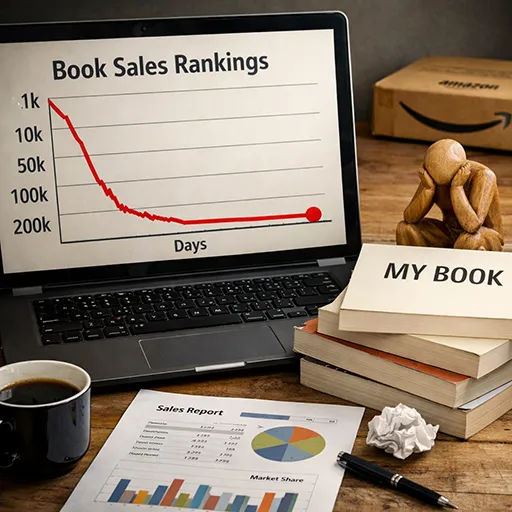
The answer is mathematical, not personal. Amazon lists well over twenty million books. A single search in any competitive category returns results drawn from hundreds of thousands of titles. The algorithm must filter. It filters on sales velocity, reviews, click behaviour, relevance signals, advertising spend, keyword matches and category fit. A new, weak-signal book appears far back in the results. What appears far back is not seen. What is not seen does not sell. What does not sell remains weak in signal.
Three paths to produce active visibility:
1. Paid advertising: Amazon Advertising, Meta Ads, BookBub Ads. Typically becomes profitable once a multi-book backlist produces follow-through sales across a series.
2. Organic growth: Author website with SEO, a directly owned newsletter list, social media presence, community engagement, guest posts, and events. Takes years to compound but builds lasting equity.
3. Algorithm bursts: Concentrated sales pulses via preorders, price promotions, Kindle Countdown deals, or limited-time free runs to boost BSR (Best Seller Rank) velocity.
7. Reviews — Trust as Craft
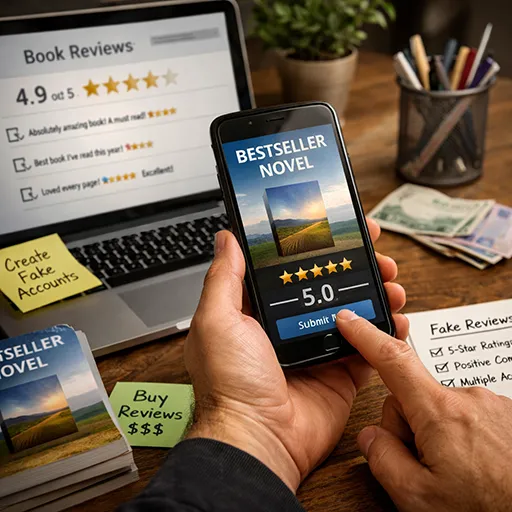
Reviews are the core trust currency in digital bookselling. A 4.5-star average across fifty or more reviews on an Amazon product page serves the function that a respected bookseller's recommendation once served: it reduces the perceived risk of the purchase. Readers rely on it.
Because reviews matter, a black market has grown around them. Amazon reports that it blocked more than 250 million suspected fake reviews on its platform in a single year. Enforcement actions have included lawsuits against more than 10,000 Facebook groups dedicated to trading paid reviews, joint lawsuits with the Better Business Bureau against commercial fake-review vendors, and cross-industry cooperation through the Coalition for Trusted Reviews alongside Booking.com, Tripadvisor and Expedia.
The legal landscape changed materially on 21 October 2024, when the Federal Trade Commission's final rule on fake reviews and testimonials entered into force. The rule prohibits the creation, sale and purchase of fake consumer reviews, the suppression of negative reviews, undisclosed reviews by company insiders, and reviews generated by AI or attributed to people who did not exist. Civil penalties can apply per violation; the maximum is adjusted periodically, so check the current FTC guidance. The rule applies to every business operating in the United States market.
Every method of obtaining artificial reviews — Fiverr and Upwork vendors, private Facebook groups, paid review services, bot networks, review-swap circles where authors trade five-star ratings — violates Amazon's policies. Most of them also now violate federal law in the United States. Authors caught risk the deletion of all reviews on the affected title, the suspension of the author account, and in the worst case direct regulatory action. The short-term gain is statistical. The long-term damage is permanent.
The legitimate path to reviews is slow. It operates through three mechanisms: polite requests to genuine buyers on the final page of the book or via newsletters; distributing Advance Reader Copies (ARCs) to vetted bloggers and BookTokers with clear disclosure; and utilizing professional ARC platforms like NetGalley, Edelweiss+, or BookSirens.
8. The Grey Zone — Vanity Presses and Push Services
Around the hopes of aspiring authors sits an industry that does not earn its money from book sales. It earns its money from the wish to become an author. Much of this industry operates inside the letter of the law. It lives on the line between a legitimate service and exploitation of inexperience.
Vanity presses, often branded today as assisted self-publishing or hybrid publishing, appear under slogans such as "authors wanted" or "seeking new voices". The classical publishing principle is straightforward: the publisher takes the commercial risk, the author receives royalties. A vanity press inverts this. The author pays a fee — often four figures, sometimes five — for editing, cover, printing and marketing. The promised deliverables are usually vague.
The services that these companies charge four-figure fees for are available free or at a fraction of the price through genuine self-publishing platforms such as KDP, IngramSpark, Draft2Digital and Barnes & Noble Press. Editing and cover design at professional quality are purchasable directly from freelancers through Reedsy, Upwork and the Editorial Freelancers Association, typically at a lower total cost than a vanity press package, with better control over who does the work.
The largest and most persistently flagged operator in this space is the Author Solutions group, which trades under an extensive list of imprints including AuthorHouse, iUniverse, Xlibris, Trafford Publishing, Palibrio, Partridge Publishing and Balboa Press. Writer Beware, the watchdog project of the Science Fiction and Fantasy Writers Association, has documented complaints and legal history against these imprints for more than two decades. The Alliance of Independent Authors watchdog advisory maintains an ongoing ratings list of publishing services and has flagged dozens of operators with concerns around transparency, quality, communication and fees. The Authors Guild Publishing Scam Alerts track newer variants, including operations run from offshore call centres that impersonate legitimate agencies and bestselling authors to extract thousands of dollars in staged fees.
Push services form the second category. The pitch: bestseller status in a short window, guaranteed visibility, chart placements. Methods range from coordinated first-day buy waves through paid accounts to purchased reviews and TikTok or Instagram bot followers. These practices typically violate both platform terms of service and, in the United States, the FTC final rule on fake reviews. Authors who buy into them pay for short-term statistical effects and take on lasting risk: account suspension, review deletion, reputational damage with readers who recognise manipulation when they see it.
Coaching programmes form the third category. "Bestseller in seven days", "six figures from a single book", "the system I used to become a millionaire". These offers sell online courses, group coaching, mastermind programmes. The actual results of the participants are usually not disclosed. The income numbers quoted by the programme owners often come from the courses themselves, not from book sales.
9. The Income Pyramid — Numbers Instead of Promises

Few topics in self-publishing are as distorted as income. Success stories are overrepresented. The large majority of authors who earn little or nothing rarely speak about it. The collective picture of the profession that results has very little to do with the statistical reality.
Key findings from Written Word Media 2025 survey:
- Around 44 percent earned 100 US dollars or less per month from their writing in 2025.
- Roughly 20 percent earned between 500 and 5,000 US dollars per month.
- Around 13 percent earned more than 5,000 US dollars per month; this is reported income, not necessarily profit.
- Approximately 8 percent reported more than 10,000 US dollars per month (a subset of the 13 percent above 5,000 US dollars).
How to Read the Income Survey:
These are selected survey results, not a complete set of non-overlapping income tiers. About 44% reported $100 or less per month; 20% reported $500–$5,000; 13% reported more than $5,000, including the 8% who reported more than $10,000. The 8% must not be added to the 13%. These figures describe respondents, not all independent authors, and do not establish net profit. Original survey.
10. Fantasy in Self-Publishing — A Special Chapter
Fantasy in the English-language market is in a transition phase. The classical position of the genre — narratively ambitious, series-oriented, with a loyal core readership — has shifted structurally under the influence of BookTok and the rise of romantasy.
The Circana BookScan data for 2025 makes the shift explicit. Total US print unit sales reached 762.4 million copies, a 0.3 percent rise over 2024. Within adult fiction, romance rose 3.9 percent to almost 44 million units. Adult fantasy, by contrast, fell 8.7 percent to 24.1 million units — in the middle of the biggest BookTok-driven genre boom of the decade. These category-level figures do not establish how much of the decline is attributable specifically to classical high fantasy or epic fantasy.
Key Rules for Indie Fantasy Authors:
1. Series are mandatory: Single standalone novels struggle in self-publishing. Readers demand multi-book series and long-form arcs.
2. Evaluate Kindle Unlimited: KU can be a substantial income source for some fantasy authors, but individual revenue shares vary and exclusivity has an opportunity cost.
3. Clear subgenre signalling: Cover art and metadata must clearly differentiate high fantasy, grimdark, progression fantasy, or romantasy to reach the correct audience.
Conclusion — The Long Road
Self-publishing is neither the solution it is often sold as, nor the dead end it is sometimes portrayed as. It is a craft with a business component, in a saturated market, with a narrow peak and a wide base.
The numbers collected in this guide do not argue away. The median qualified indie author earns around 13,500 US dollars per year. Around 44 percent of surveyed indie authors earn 100 US dollars or less per month. Roughly 8 percent clear 10,000 US dollars per month or more. The US alone produced more than four million ISBN-registered titles in 2025, rising at over 30 percent per year. The UK fiction market is at record revenue. Visibility is harder to earn than at any point in publishing history.
The question is not whether self-publishing is worthwhile. The question is what the individual author calls worthwhile. An author who writes a book because they want to have written it, and who publishes it at professional quality, has a route to readers that was unreachable twenty years ago. An author who wants a primary income from writing needs craft, endurance, marketing sense, financial stamina across two to five years of buildup, a working genre and usually a series of multiple volumes. An author aiming for the bestseller layer should register that fewer than one percent of indie authors reach that tier.
Sources and scope
These figures describe different survey populations and should not be combined into a single income distribution. Cost ranges are illustrative calculations, not an industry-wide average.
Written Word Media – 2025 indie author survey ALLi – indie author income facts Bowker statistics reported by Publishers Weekly Circana BookScan figures reported by Publishers Weekly Google Play Books – official royalty terms IngramSpark – official trade discount guide FTC – Consumer Review Rule enforcement
Frequently Asked Questions About Self-Publishing
Is self-publishing still financially worthwhile?
For the majority, it is not. The Alliance of Independent Authors 2025 Indie Author Income Survey reports a median annual income of around 13,500 US dollars for qualified indie authors — those who spend at least fifty percent of their working time on writing and publishing. The Written Word Media 2025 survey of 1,346 indie authors shows that roughly 44 percent earn 100 US dollars or less per month, about 13 percent earn more than 5,000 US dollars per month, and about 8 percent report more than 10,000 US dollars per month (included in the 13 percent). Self-publishing rewards professional, persistent authors with a backlist of multiple titles. It is not a quick path to a full-time income.
Which platform is best for indie authors in the US and UK?
There is no single best platform. Amazon Kindle Direct Publishing dominates the English-language e-book market with 70 to 80 percent share. For physical bookstore distribution in the US, UK, Australia and beyond, IngramSpark is the standard route because it plugs into the Ingram Content Group wholesale network and reaches over 45,000 retailers including Barnes & Noble, Waterstones and independent bookshops. Apple Books, Kobo Writing Life, Barnes & Noble Press and Google Play Books cover the remaining e-book market. Aggregators such as Draft2Digital distribute to multiple stores from a single dashboard. Serious authors usually combine KDP with IngramSpark, plus at least one aggregator for reach.
What does it cost to self-publish a book?
On Amazon KDP, IngramSpark, Draft2Digital and most other platforms, the upload itself is free. Costs come from professional services: developmental and copy editing typically ranges from 0.02 to 0.05 US dollars per word, proofreading from 0.01 to 0.02 US dollars per word, cover design from 300 to 2,000 US dollars depending on complexity and illustration, and interior formatting from nothing if handled in Vellum or similar software up to 500 dollars for outsourced work. A professionally published novel realistically costs between 3,000 and 8,000 US dollars before any advertising spend. Advertising budgets are separate and ongoing.
Why are vanity presses and assisted self-publishing companies problematic?
Vanity presses charge authors four- or five-figure fees for services that genuine self-publishing platforms such as KDP, IngramSpark or Draft2Digital provide for free or at a fraction of the price. Watchdog organisations including Writer Beware, run by the Science Fiction and Fantasy Writers Association, the Alliance of Independent Authors watchdog advisory service, and the Authors Guild publish ongoing warnings about companies in this sector. The largest and most frequently flagged group is Author Solutions, which operates under many imprints such as AuthorHouse, iUniverse, Xlibris, Trafford, Palibrio, Partridge Publishing and Balboa Press. The principle is simple: a legitimate publisher takes the commercial risk. If you are paying to be published, you are not working with a publisher. You are working with a service provider — often at a heavy markup.
Is fantasy still a successful genre in self-publishing?
Fantasy remains one of the top three genres for indie authors alongside romance and crime/thriller, but the internal picture has shifted. Circana BookScan data for the US print market in 2025 shows adult fantasy print sales falling 8.7 percent to 24.1 million units, while romance rose 3.9 percent to almost 44 million units. Romantasy contributed to romance sales, but the overall print-category figures alone do not isolate sales of classical high fantasy or epic fantasy. They require patience, long series, high word counts and readers willing to invest in worldbuilding rather than chasing tropes. Authors in this space should plan for a multi-book series, not a standalone, and should expect a slow build across two to five years.